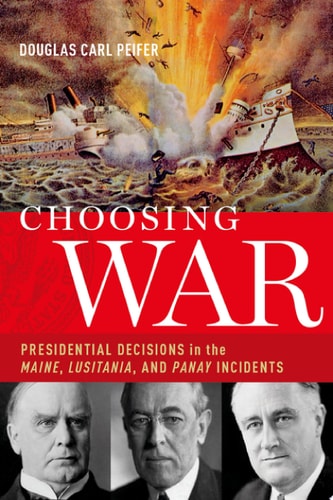
Choosing War
0
0
As an Amazon Associate and affiliate partner, Menrva Books earns from qualifying purchases. Learn more
Author Description
Throughout Us History, Presidents Have Had Vastly Different Reactions To Naval Incidents. Though Some Incidents Have Been Resolved Diplomatically, Others Have Escalated To Outright War. What Factors Influence The Outcome Of A Naval Incident, Especially When Calls For Retribution Mingle With Recommendations For Restraint? Given The Rise Of Long Range Anti-ship And Anti-air Missile Systems, Coupled With Tensions In East Asia, The Persian Gulf, And The Black And Baltic Seas, The Question Is More Relevant Than Ever For Us Naval Diplomacy. In Choosing War, Douglas Carl Peifer Compares The Ways In Which Different Presidential Administrations Have Responded When American Lives Were Lost At Sea. He Examines In Depth Three Cases: The Maine Incident (1898), Which Led To War In The Short Term; The Lusitania Crisis (1915), Which Set The Trajectory For Intervention; And The Panay Incident (1937), Which Was Settled Diplomatically. While Evaluating Presidents William Mckinley, Woodrow Wilson, And Franklin Delano Roosevelt's Responses To These Incidents, Peifer Lucidly Reflects On The Options They Had Available And The Policies They Ultimately Selected. The Case Studies Illuminate How Leadership, Memory, And Shifting Domestic Policy Shape Presidential Decisions, Providing Significant Insights Into The Connections Between Naval Incidents, War, And Their Historical Contexts. Rich In Dramatic Narrative And Historical Perspective, Choosing War Offers An Essential Tool For Confronting Future Naval Crises.
Menrva's Summary
THE THESIS
This book investigates the specific variables and decision-making processes that determine whether a naval incident involving American lives results in diplomatic resolution or military escalation. Douglas Carl Peifer, a professor at the U.S. Air War College, utilizes historical analysis to examine how presidential leadership, domestic political pressure, and collective memory influence foreign policy outcomes. By evaluating the responses of three distinct administrations, the author constructs a framework for understanding the constraints and options available to leaders during moments of maritime crisis.
THE SCOPE MAP
What You Will Find
- Comparative analysis of the Maine incident, the Lusitania crisis, and the Panay incident.
- Examination of presidential decision-making under the administrations of McKinley, Wilson, and Roosevelt.
- Assessment of the interplay between public opinion, naval diplomacy, and historical context.
Scope Limits
- The study focuses primarily on twentieth-century American naval history and does not provide a comprehensive survey of all global naval conflicts.
- The analysis does not cover modern technological warfare scenarios in exhaustive detail, focusing instead on the historical precedents for crisis management.
THE AUTHORITY PERSPECTIVE
Historians and military scholars recognize this work as a rigorous examination of the intersection between executive leadership and naval policy. Readers frequently note the clarity of the case studies and the author's ability to synthesize complex historical data into actionable insights for contemporary diplomacy.
Page Count:
336
Publication Date:
2016-01-01
Publisher:
Oxford University Press
ISBN-10:
0190268697
ISBN-13:
9780190268695
History
International relations
Naval history
United States
Military History
Community Tags
Similar Books