C++ for Fortran Programmers
0
0
As an Amazon Associate and affiliate partner, Menrva Books earns from qualifying purchases. Learn more
Author Description
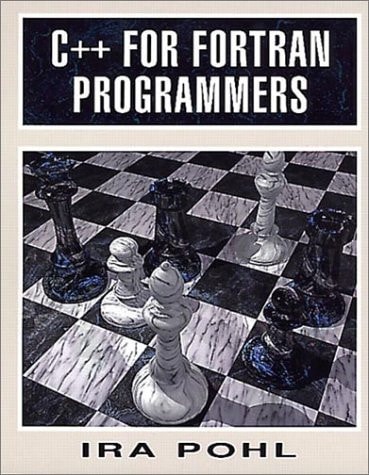
Using your existing knowledge of Fortran, C++ for Fortran Programmers gets you up and running with C++ quickly. By learning how individual elements of a Fortran program compare and translate into C++, this book helps you make a smooth transition to C++ and object-oriented concepts. Best-selling author and C++ authority, Ira Pohl, uses his trademark "dissection" technique to illustrate the underlying structure of programs and help you understand design trade-offs. Scientific and engineering coding examples are featured throughout the text.The book provides a smooth transition to C++ and object-oriented programming for programmers already familiar with Fortran, and includes C++ to Fortran equivalencies making it easy to move from one language to another. Engineering computations are featured throughout; important scientific types such as complex number, vector and polynomial are implemented. It also incorporates the proposed ANSI C++ Standard including bool, namespaces, and the STL library, and features a chapter on the use of STL and efficient generic programming. All program code is fully tested and available on the World Wide Web.
Menrva's Summary
THE THESIS
This book investigates the most efficient methodology for transitioning experienced Fortran programmers into the C++ language by leveraging their existing knowledge base. Author Ira Pohl, a recognized authority in C++ programming, utilizes his signature dissection technique to break down complex code structures. By mapping Fortran syntax and logic directly to C++ equivalents, the text provides a structured framework for understanding object-oriented design and modern programming standards. The material focuses on scientific and engineering applications to ensure the transition remains relevant to the reader's professional domain.
THE SCOPE MAP
What You Will Find
- Comparative analysis of Fortran and C++ syntax and structural paradigms.
- Implementation of scientific data types including complex numbers, vectors, and polynomials.
- Coverage of ANSI C++ standards, namespaces, and the Standard Template Library (STL).
- Practical engineering computation examples and generic programming techniques.
THE AUTHORITY PERSPECTIVE
Experts and educators frequently cite this text as a highly effective bridge for legacy programmers moving into modern object-oriented environments. Readers often note that the technical density is well-balanced for those who already possess a strong foundation in computational logic.
Page Count:
540
Publication Date:
1997-01-01
Publisher:
Addison-Wesley
ISBN-10:
0201924838
ISBN-13:
9780201924831
Computer Science
Programming
Fortran
C++
Engineering
Community Tags
Similar Books