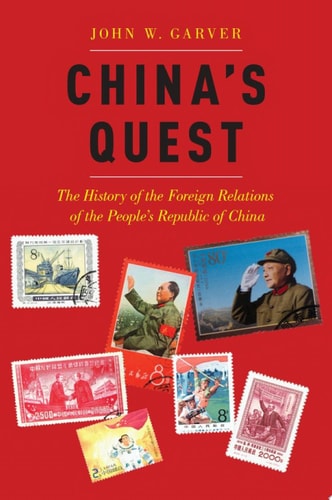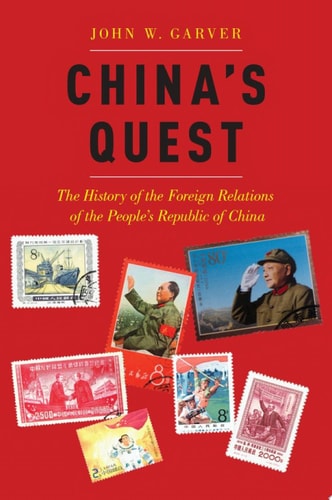
China's Quest: The History of the Foreign Relations of the People's Republic of China
0
0
As an Amazon Associate and affiliate partner, Menrva Books earns from qualifying purchases. Learn more
Author Description
From its founding 65 years ago, the People's Republic of China has evolved from an important yet chaotic and impoverished state whose power was more latent than real into a great power on the cusp of possessing the largest economy in the world. Its path from the 1949 revolution to the present has been filled with twists and turns, including internal upheavals, a dramatic break with the Soviet Union, the 1989 revolution wave, and various wars and quasi-wars against India, the USSR, Vietnam, and South Korea. Throughout it all, international pressures have been omnipresent, forcing the regime to periodically shift course. In short, the evolution of the PROC in world politics is an epic story and one of the most important developments in modern world history. Yet to date, there has been no authoritative history of China's foreign relations.John Garver's monumental China's Quest not only addresses this gap; it will almost certainly serve as the definitive work on the topic for years to come. Garver, one of the world's leading scholars of Chinese foreign policy, covers a vast amount of ground and threads a core argument through the entirety of his account: domestic political concerns-regime survival in particular-have been the primary force driving the People's Republic's foreign policy agenda. The objective of communist regime survival, he argues, transcends the more rudimentary pursuit of national interests that realists focus on. Indeed, from 1949 onward, domestic politics has been integral to the PROC's foreign policy choices. Over the decades, the regime's decisions in the realm of international politics have been dictated concerns about internal stability. In the early days of the regime, Mao and other part leaders were concerned with surviving in the face of American aggression. Later, they came to see the post-Stalinist Soviet model as a threat to their revolutionary program and initiated a stunning break with Khrushchev regime. Finally, the collapse of other comm
Menrva's Summary
THE THESIS
This work investigates how the internal political imperatives of the Chinese Communist Party have shaped the foreign policy trajectory of the People's Republic of China since 1949. John W. Garver, a prominent scholar in Chinese foreign policy, utilizes a vast array of historical records and diplomatic analysis to argue that regime survival is the primary driver of China's international conduct. He posits that domestic stability concerns consistently override traditional realist interpretations of national interest, providing a framework for understanding China's shifts from revolutionary isolation to global power status.
THE SCOPE MAP
What You Will Find
- A comprehensive chronological history of the People's Republic of China's foreign relations from 1949 to the present.
- Analysis of major geopolitical conflicts including the Sino-Soviet split and border wars with India and Vietnam.
- A theoretical framework linking internal regime security to external diplomatic maneuvering.
Scope Limits
- The text focuses primarily on state-level diplomatic and political strategy rather than cultural or social history.
- It does not provide an exhaustive analysis of contemporary economic policy outside of its relationship to regime survival.
THE AUTHORITY PERSPECTIVE
Experts recognize this volume as a foundational text for understanding the historical continuity of Chinese foreign policy. Readers frequently note the academic density of the prose, which provides a rigorous and detailed account suitable for scholars and serious students of international relations.
Page Count:
868
Publication Date:
2015-01-01
Publisher:
Oxford University Press
ISBN-10:
0190261072
ISBN-13:
9780190261078
History
Asian Studies
International relations
Modern History
Asian History
Foreign Policy
Community Tags
Similar Books