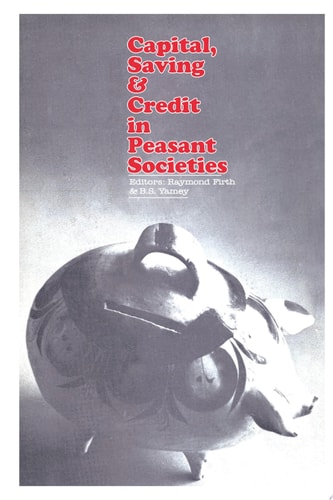
Capital, Saving and Credit in Peasant Societies
0
0
As an Amazon Associate and affiliate partner, Menrva Books earns from qualifying purchases. Learn more
Author Description
Contemporary problems of economic and social change have obliged social scientists from different fields to learn much about each others' work as well as about the specific problems they are together seeking to solve. The bearing of economic conditions on the character of a social system has become more apparent to anthropologists, and, similarly, economists have become more aware of the relevance of social factors to economic decisions. This pioneering book is at the point of contact between these two disciplines, presenting detailed studies from many societies of the interaction between social and economic relationships.The studies in this volume--all by social anthropologists --focus on the formation and management of capital, since this process is central to the economic functioning and growth of all societies. With this central theme, the essays cover a very wide geographic range and an equally wide range of social and economic structures. The book begins with an essay by Firth, who provides an extended outline discussion of the main problems and issues to be covered, and ends with an essay by Yamey, who provides summarizing comments and queries.The volume will be especially useful to those concerned with the problems and prospects of economic and social change in underdeveloped areas, in addition to economists and anthropologists concerned with what each can learn from the other.
Menrva's Summary
THE THESIS
This volume investigates the complex interplay between social structures and economic behavior, specifically focusing on how capital, saving, and credit function within diverse peasant societies. Edited by B. S. Yamey and Raymond Firth, the work brings together social anthropologists to examine the mechanisms of capital formation. The authors argue that economic growth and stability in these regions cannot be understood without accounting for the underlying social relationships that govern resource management and financial decision-making.
THE SCOPE MAP
What You Will Find
- Comparative analysis of capital formation and management across diverse global peasant societies.
- Theoretical frameworks bridging the gap between economic theory and anthropological observation.
- Case studies illustrating the impact of social norms on credit and saving behaviors.
- Synthesis of the intersection between economic development and traditional social systems.
THE AUTHORITY PERSPECTIVE
Experts recognize this volume as a foundational interdisciplinary text that successfully bridges the gap between economic theory and social anthropology. Readers frequently note the academic density of the prose, highlighting its value as a primary reference for scholars studying economic development in non-industrialized regions.
Page Count:
398
Publication Date:
2007-03-15
Publisher:
Routledge
ISBN-10:
0202309185
ISBN-13:
9780202309187
Economics
Anthropology
Developing Countries
Social Science
Sociology
Agriculture
Community Tags
Similar Books