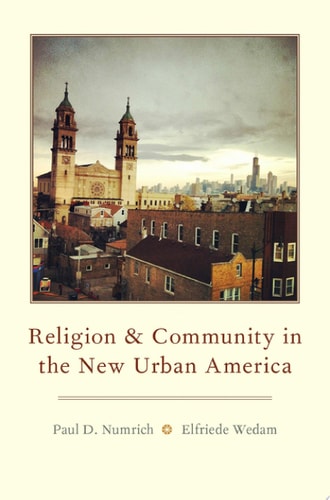
Religion and Community in the New Urban America
0
0
As an Amazon Associate and affiliate partner, Menrva Books earns from qualifying purchases. Learn more
Author Description
Religion and Community in the New Urban America examines the interrelated transformations of cities and urban congregations. The authors ask how the new metropolis affects local religious communities and what role those communities play in creating the new metropolis. Through an in-depth study of fifteen Chicago congregations-Catholic parishes, Protestant churches, Jewish synagogues, Muslim mosques, and a Hindu temple, both city and suburban-this book describes congregational life and measures congregational influences on urban environments. Paul D. Numrich and Elfriede Wedam challenge the view held by many urban studies scholars that religion plays a small role-if any-in shaping postindustrial cities and that religious communities merely adapt to urban structures in a passive fashion. Taking into account the spatial distribution of constituents, internal traits, and external actions, each congregation's urban impact is plotted on a continuum of weak, to moderate, to strong, thus providing a nuanced understanding of the significance of religion in the contemporary urban context. Presenting a thoughtful analysis that includes maps of each congregation in its social-geographic setting, the authors offer an insightful look into urban community life today, from congregations to the places in which they are embedded.
Menrva's Summary
THE THESIS
This book investigates the reciprocal relationship between urban development and local religious congregations in the contemporary American metropolis. Authors Elfriede Wedam and Paul D. Numrich, both established scholars in sociology and religious studies, utilize a comparative case study framework to analyze how religious institutions influence urban social structures. They argue against the prevailing academic assumption that religion is a passive or negligible force in postindustrial cities, proposing instead that congregations actively shape their surrounding environments.
THE SCOPE MAP
What You Will Find
- A comparative analysis of fifteen diverse religious congregations in Chicago, including Catholic, Protestant, Jewish, Muslim, and Hindu institutions.
- A methodological framework that plots congregational impact on a continuum ranging from weak to strong influence.
- Social-geographic maps illustrating the spatial distribution of congregational constituents.
Scope Limits
- The study is geographically confined to the Chicago metropolitan area and may not account for regional variations in other urban centers.
- The research focuses primarily on institutional congregational life rather than individual private religious practice.
THE AUTHORITY PERSPECTIVE
Experts recognize this work as a significant contribution to the sociology of religion for its empirical approach to measuring institutional influence. Readers frequently note the academic density of the prose and the utility of the spatial mapping methodology for urban planning and sociological research.
Page Count:
368
Publication Date:
2015-01-01
Publisher:
Oxford University Press
ISBN-10:
019026666X
ISBN-13:
9780190266660
Religion
Chicago History
Sociology
Urban Studies
Community Studies
Community Tags
Other Editions(2)
Similar Books