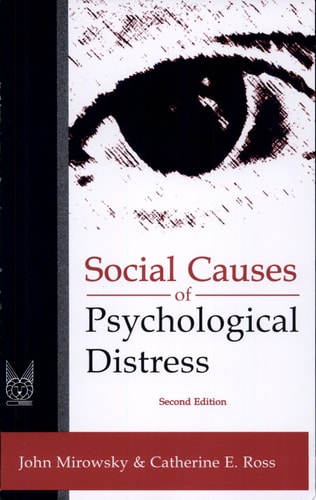
Social Causes of Psychological Distress
0
0
As an Amazon Associate and affiliate partner, Menrva Books earns from qualifying purchases. Learn more
Author Description
A core interest of social science is the study of stratification--inequalities in income, power, and prestige. Few persons would care about such inequalities if the poor, powerless, and despised were as happy and fulfilled as the wealthy, powerful, and admired. Social research often springs from humanistic empathy and concern as much as from scholarly and scientific curiosity. An economist might observe that black Americans are disproportionately poor, and investigate racial differences in education, employment, and occupation that account for disproportionate poverty. A table comparing additional income blacks and whites can expect for each additional year of education is thus as interesting in its own right as any dinosaur bone or photo of Saturn. However, something more than curiosity underscores our interest in the table. Racial differences in status and income are a problem in the human sense. Inequality in misery makes social and economic inequality personally meaningful. There are two ways social scientists avoid advocacy in addressing issues of social stratification. The first way is to resist projecting personal beliefs, values, and responses as much as possible, while recognizing that the attempt is never fully successful. The second way is by giving the values of the subjects an expression in the research design. Typically, this takes the form of opinion or attitude surveys. Researchers ask respondents to rate the seriousness of crimes, the appropriateness of a punishment for a crime, the prestige of occupations, the fair pay for a job, or the largest amount of money a family can earn and not be poor, and so on. The aggregate judgments, and variations in judgments, represent the values of the subjects and not those of the researcher. They are objective facts with causes and consequences of interest in their own right. This work is an effort to move methodology closer to human concerns without sacrificing the scientific grounds of research as such.
Menrva's Summary
THE THESIS
This work investigates the causal relationship between social stratification and psychological distress, arguing that inequalities in income, power, and prestige are fundamental drivers of human misery. Catherine E. Ross and John Mirowsky, both established scholars in medical sociology, utilize extensive survey data and rigorous quantitative methods to bridge the gap between humanistic concern for social inequality and objective scientific inquiry. They propose a framework that incorporates the subjective values of research subjects into the study of social structures, ensuring that the analysis remains grounded in both empirical data and the lived reality of the population.
THE SCOPE MAP
What You Will Find
- Quantitative analysis of the correlation between socioeconomic status and mental health outcomes.
- Methodological frameworks for integrating subjective human values into objective social research.
- Examination of how racial and economic disparities manifest as psychological distress.
- Discussion on the role of social science in addressing human inequality without sacrificing scientific neutrality.
THE AUTHORITY PERSPECTIVE
Experts in the field of medical sociology recognize this text as a foundational resource for understanding the structural determinants of mental health. Readers frequently note the academic density of the prose, which serves as a rigorous guide for students and researchers interested in the intersection of social stratification and psychological well-being.
Page Count:
328
Publication Date:
2003-01-01
Publisher:
Aldine Transaction, Paperback(2003)
ISBN-10:
0202307093
ISBN-13:
9780202307091
Psychology
Inequality
Affective disorders
Sociology
Mental Health
Social Science
Community Tags
Similar Books