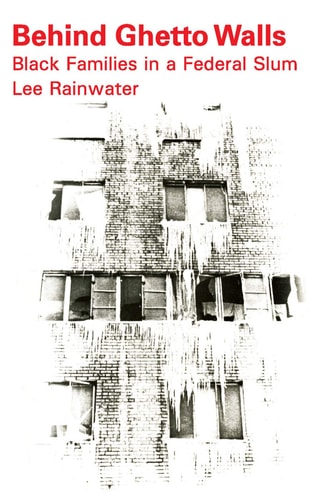
Behind Ghetto Walls: Black Families in a Federal Slum
0
0
As an Amazon Associate and affiliate partner, Menrva Books earns from qualifying purchases. Learn more
Author Description
This book is about the family lives of some 10,000 children and adults who live in an all-Negro public housing project in St Louis. The Pruitt-Igoe project is only one of the many environments in which urban Negro Americans lived in the 1960s, but the character of the family life there shares much with the family life of lower-class Negroes as it has been described by other investigators in other cities and at other times, in Harlem, Chicago, New Orleans, or Washington D.C. This book is primarily concerned with private life as it is lived from day to day in a federally built and supported slum. The questions, which are treated here, have to do with the kinds of interpersonal relationships that develop in nuclear families, the socialization processes that operate in families as children grow up in a slum environment, the informal relationships of children and adolescents and adults with each other, and, finally, the world views (the existential framework) arising from the life experiences of the Pruitt-Igoeans and the ways they make use of this framework to order their experiences and make sense out of them. The lives of these persons are examined in terms of life cycles. Each child there is born into a constricted world, the world of lower class, Negro existence, and as he grows he is shaped and directed by that existence through the day-to-day experiences and relationships available to him. The crucial transition from child of a family; to progenitor of a new family begins in adolescence, and for this reason the book pays particular attention to how each new generation of parents expresses the cultural and social structural forces that formed it and continue to constrain its behavior. This book, in short, is about intimate personal life in a particular ghetto setting. It does not analyze the larger institutional, social structural, and ideological forces that provide the social, economic, and political context in which lower-class Negro life is lived.
Menrva's Summary
THE THESIS
This study investigates the internal social dynamics and existential frameworks of families residing within the Pruitt-Igoe public housing project in St. Louis during the 1960s. Lee Rainwater, a sociologist, utilizes extensive ethnographic observation and interviews to document the daily lives of residents in this federally subsidized environment. The work argues that the constraints of lower-class existence in a segregated urban setting fundamentally shape the socialization processes, interpersonal relationships, and world views of the inhabitants across their life cycles.
THE SCOPE MAP
What You Will Find
- Detailed analysis of nuclear family structures and socialization patterns within a public housing environment.
- Examination of the life cycle from childhood through adolescence to parenthood in a segregated urban setting.
- Qualitative data derived from long-term ethnographic observation of residents in the Pruitt-Igoe project.
- Exploration of the existential frameworks and world views developed by residents to navigate their social reality.
THE AUTHORITY PERSPECTIVE
Experts recognize this work as a foundational ethnographic study of urban poverty and the social consequences of public housing policy in mid-century America. Scholars frequently cite the text for its detailed focus on the micro-level experiences of residents, noting its significance in understanding the cultural and structural constraints of the era.
Page Count:
596
Publication Date:
2006-07-15
Publisher:
Routledge
ISBN-10:
020230907X
ISBN-13:
9780202309071
Social History
Urban Studies
Public Housing
Sociology
African Americans
Community Tags
Similar Books