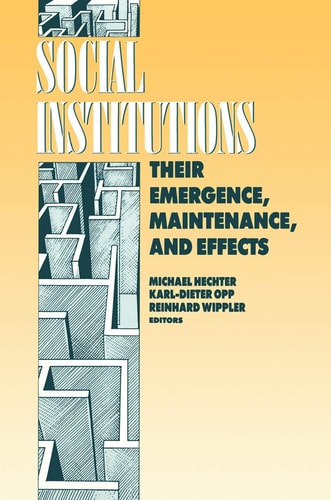
Social Institutions: Their Emergence, Maintenance and Effects
0
0
As an Amazon Associate and affiliate partner, Menrva Books earns from qualifying purchases. Learn more
Author Description
This is the first book to present a synthesis of rational choice theory and sociological perspectives for the analysis of social institutions.The origin of social institutions is an old concern in social theory. Currently it has re-emerged as one of the most intensely debated issues in social science. Among economists and rational choice theorists, there is growing awareness that most, if not all, of the social outcomes that are of interest to explain are at least partly a function of institutional constraints. Yet the role of institutions is negligible both in general equilibrium theory and in most neoclassical economic models. There is a burgeoning substantive interest in institutions ranging from social movements, to formal organizations, to states, and even international regimes.Rational choice theorists have made great strides in elucidating the effects of institutions on a variety of social outcomes, but they have paid insufficient attention to the social dynamics that lead to the emergence of these institutions. Typically, these institutions have been assumed to be a given, rather than considered as outcomes requiring explanation in their own right. Sociological theorists, in contrast, have long appreciated the role of social structural constraints in the determination of outcomes but have neglected the role of individual agents.
Menrva's Summary
THE THESIS
How do social institutions emerge, persist, and influence individual behavior within a framework that bridges rational choice theory and traditional sociology? The authors, Karl-Dieter Opp, Michael Hechter, and Reinhard Wippler, utilize their extensive academic backgrounds in sociology and theoretical modeling to address the historical divide between economic rationalism and structural sociology. They argue that institutions should not be treated as exogenous constants but as endogenous outcomes of individual agency, proposing a synthesis that accounts for both micro-level motivations and macro-level structural constraints.
THE SCOPE MAP
What You Will Find
- Theoretical synthesis of rational choice theory and sociological structuralism
- Analysis of the emergence and maintenance of social institutions
- Examination of institutional effects on social outcomes
- Case studies ranging from social movements to international regimes
THE AUTHORITY PERSPECTIVE
Scholars in the social sciences frequently cite this work as a foundational text for understanding the intersection of individual agency and institutional stability. Readers often note the high level of academic density, making it a primary resource for advanced students and researchers in sociology and economics.
Page Count:
350
Publication Date:
1990-12-31
Publisher:
Routledge
ISBN-10:
0202304094
ISBN-13:
9780202304090
Economics
Social choice
Sociology
Social Theory
Rational choice theory
Community Tags
Similar Books