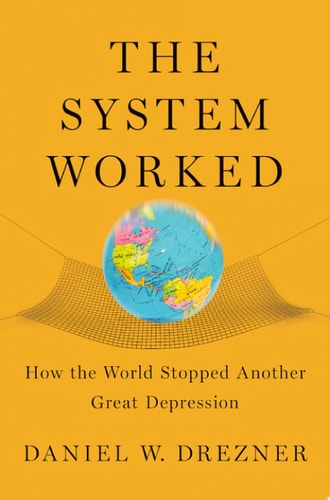
The System Worked: How the World Stopped Another Great Depression
0
0
As an Amazon Associate and affiliate partner, Menrva Books earns from qualifying purchases. Learn more
Author Description
International institutions, from the International Monetary Fund to the International Olympic Committee, are perceived as bastions of sclerotic mediocrity at best and outright corruption at worst, and this perception is generally not far off the mark. In the wake of the 2008 financial crash, Daniel W. Drezner, like so many others, looked at the smoking ruins of the global economy and wondered why global economic governance structure had failed so spectacularly, and what could be done to reform them in the future. But then a funny thing happened. As he surveyed their actions in the wake of the crash, he realized that the evidence pointed to the exact opposite conclusion: global economic governance had succeeded.In The System Worked, Drezner, a renowned political scientist and international relations expert, contends that despite the massive scale and reverberations of this latest crisis (larger, arguably, than those that precipitated the Great Depression), the global economy has bounced back remarkably well. Examining the major resuscitation efforts by the G-20 IMF, WTO, and other institutions, he shows that, thanks to the efforts of central bankers and other policymakers, the international response was sufficiently coordinated to prevent the crisis from becoming a full-fledged depression. Yet the narrative about the failure of multilateral economic institutions persists, both because the Great Recession affected powerful nations whose governments managed their own economies poorly, and because the most influential policy analysts who write the books and articles on the crisis hail from those nations. Nevertheless, Drezner argues, while it's true that the global economy is still fragile, these institutions survived the "stress test" of the financial crisis, and may have even become more resilient and valuable in the process.Bucking the conventional wisdom about the new "G-Zero World," Drezner rehabilitates the image of the much-maligned international institutions and
Menrva's Summary
THE THESIS
This book investigates why global economic governance institutions successfully prevented a second Great Depression following the 2008 financial crash, despite widespread public perception of their failure. Daniel W. Drezner, a professor of international politics, utilizes his expertise in global governance to analyze the response of organizations like the G-20, IMF, and WTO. He argues that while the public narrative focuses on the incompetence of these bodies, the empirical evidence suggests that coordinated policy efforts effectively stabilized the global economy during a period of extreme volatility.
THE SCOPE MAP
What You Will Find
- Analysis of the 2008 financial crisis and its immediate aftermath
- Evaluation of the G-20, IMF, and WTO response mechanisms
- Examination of the disconnect between public perception and institutional performance
Scope Limits
- Does not provide a comprehensive history of all international institutions
- Does not focus on the internal domestic politics of individual nations beyond their interaction with global governance
THE AUTHORITY PERSPECTIVE
Experts in international relations frequently cite this work as a necessary counter-narrative to the prevailing cynicism regarding multilateral institutions. Readers often note that the prose is accessible to non-specialists while maintaining the analytical rigor expected of a political science text.
Page Count:
288
Publication Date:
2016-01-01
Publisher:
Oxford University Press
ISBN-10:
0190263393
ISBN-13:
9780190263393
Economics
History
International relations
Recessions
Finance
Community Tags
Similar Books