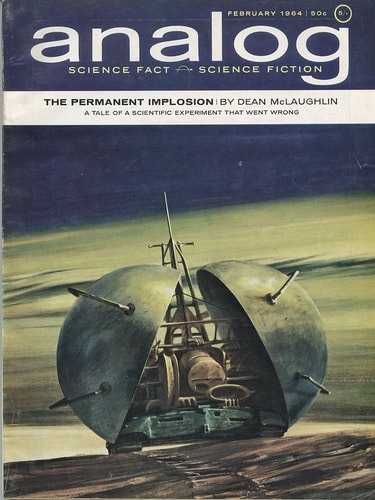
Analog: February 1964
0
0
As an Amazon Associate and affiliate partner, Menrva Books earns from qualifying purchases. Learn more
Author Description
Cover Art by John SChoenherr. Stories: Secondary Meteorites by Ralph A. Hall MD, Names for Space Plants by John Becker, The Permanent Implosion byDean McLaughlin, Crackpots Inc. by Richard L. Davis, Rx for Chaos by Christopher Anvil, Dune World by Frank Herbert. Analog Science Fiction and Fact is the longest-running science fiction magazine. The Brass Tacks of science fiction, also considered Scientist Fiction b/c getting facts right is as important as plot line. George R.R. Martin described Analog as having "the reputation of being hard-nosed, steel-clad, scientifically rigorous, and perhaps a bit puritanical." The "it-could-happen" sci-fi magazine and winner of numerous Hugo and Nebula Awards.
Menrva's Summary
THE PULSE
This issue of Analog Science Fiction and Fact presents a collection of speculative narratives centered on the intersection of rigorous scientific extrapolation and human ingenuity.
The magazine features a variety of protagonists navigating complex technological and environmental challenges, ranging from space exploration to societal collapse. These stories operate within the 'hard' science fiction framework, where physical laws and logical consistency dictate the boundaries of the narrative. The collection includes the serialized debut of Frank Herbert's seminal work, Dune World, alongside shorter pieces that explore the practical implications of future advancements. The narrative structures vary from technical procedural accounts to character-driven explorations of survival and innovation.
INSIDE THE PAGES
- Serialization of Frank Herbert's foundational science fiction epic, Dune World.
- Technical exploration of space-based biological and environmental challenges.
- Emphasis on scientific accuracy and plausible technological extrapolation.
- Inclusion of editorial commentary on the state of the genre.
- Diverse narrative perspectives ranging from medical professionals to space pioneers.
- Focus on the 'it-could-happen' philosophy of speculative writing.
- Integration of scientific fact-based articles alongside fictional narratives.
- Exploration of the societal impacts of rapid technological change.
THE COLLECTIVE ECHO
Readers and critics frequently identify this publication as a cornerstone of the hard science fiction subgenre. Discussion often centers on the magazine's commitment to scientific rigor, which distinguishes it from more speculative or fantasy-leaning periodicals. Enthusiasts highlight the balance between technical detail and narrative pacing, noting that the stories prioritize logical consistency over stylistic flourishes. The inclusion of early Dune material remains a primary point of interest for historical analysis of the genre's evolution. Critics often observe that the magazine maintains a distinct, disciplined tone that appeals to readers who value intellectual engagement alongside traditional storytelling.
Page Count:
98
Publication Date:
1964-02-01
Publisher:
Conde Nast
ISBN-10:
0202864022
ISBN-13:
9780202864020
Science Fiction
Short Stories
Anthology
Periodicals