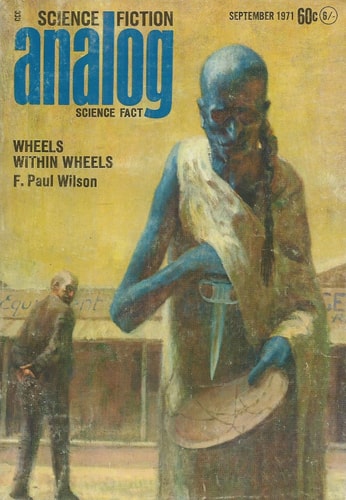
Analog Science Fiction and Fact, September 1971
0
0
As an Amazon Associate and affiliate partner, Menrva Books earns from qualifying purchases. Learn more
Author Description
Analog Science Fiction / Science Fact, September 1971 (Vol. LXXXVIII, No. 1) edited by John W. Campbell, with cover art by John Schoenherr and interior illustrations by John Schoenherr, Kelly Freas, and Vincent Di Fate. Fiction and non-fiction contents include: The Lion Game, part two of a two-part serial by James H. Schmitz; Wheels Within Wheels, a novelette by F. Paul Wilson; The Fine Print, a novelette by John T. Phillifent; To Make a New Neanderthal, a short story by W. Macfarlane; Knight Errant, a short story by Jack Wodhams; Strong Poison 1, a science fact article by Carl A. Larson; and Ecological Notes, an editorial by John W. Campbell. Regular features include: The Analytical Laboratory; In Times to Come; The Reference Library, with book reviews by P. Schuyler Miller; and Brass Tacks, with letters from the readers.
Menrva's Summary
THE PULSE
This issue of Analog Science Fiction and Fact presents a collection of speculative narratives and analytical articles centered on the intersection of human ingenuity and extraterrestrial or future environments. The editorial focus, curated by John W. Campbell, explores the logical consequences of technological and biological advancement. The contributors utilize varied narrative frameworks, ranging from serialized space opera to grounded novelettes, to examine how characters navigate complex social and scientific constraints. The issue maintains a consistent tone of rigorous inquiry, emphasizing the technical and ethical dilemmas inherent in the genre.
INSIDE THE PAGES
- Serialized narrative structure in The Lion Game by James H. Schmitz
- Novelette-length explorations of speculative technology and societal structures
- Inclusion of science fact articles addressing biological and ecological themes
- Editorial commentary on contemporary scientific and social issues
- Regular reader correspondence section providing community feedback
- Book review column covering contemporary science fiction literature
- Speculative fiction focusing on human adaptation and evolutionary theory
- Integration of illustrative art to complement the textual world-building
THE COLLECTIVE ECHO
Readers and critics frequently highlight the influence of John W. Campbell’s editorial vision on the development of hard science fiction during this era. Discussion often centers on the technical precision of the novelettes and the balance between speculative fiction and the accompanying science fact articles. The inclusion of established authors like James H. Schmitz and F. Paul Wilson is noted for maintaining a high standard of narrative quality within the magazine format. Critics often point to the Analytical Laboratory as a significant feature that fostered direct engagement between the readership and the editorial direction of the publication. The overall atmosphere is described as intellectually demanding, prioritizing logical consistency and scientific plausibility over purely emotional storytelling.
Page Count:
178
Publication Date:
1971-01-01
Publisher:
Conde Nast
ISBN-10:
0202871096
ISBN-13:
9780202871097
Science Fiction
Anthology
Short Stories
Periodicals