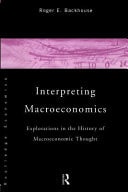
Interpreting Macroeconomics: Explorations in the History of Macroeconomic Thought
0
0
As an Amazon Associate and affiliate partner, Menrva Books earns from qualifying purchases. Learn more
Author Description
Interpreting Macroeconomics explores a variety of different approaches to macroeconomic thought. The book considers a number of historiographical and methodological positions, as well as analyzing various important episodes in the development of macroeconomics, before during and after the Keynesian revolution. Roger Backhouse shows that the full richness of these developments can only by brought out by approaches which blend both relativism and absolutism, and historical and rational reconstructions. Examples discussed include Hobson, Keynes and Friedman.
Menrva's Summary
THE THESIS
This work investigates how different historiographical and methodological frameworks shape our understanding of the evolution of macroeconomic thought. Roger E. Backhouse, a noted historian of economics, evaluates the development of the field by examining the interplay between relativist and absolutist interpretations. He argues that a comprehensive grasp of macroeconomic history requires a synthesis of historical context and rational reconstruction, moving beyond singular analytical perspectives to capture the full complexity of the discipline.
THE SCOPE MAP
What You Will Find
- Analysis of macroeconomic thought before, during, and after the Keynesian revolution.
- A comparative study of historiographical and methodological approaches to economic history.
- Case studies focusing on influential figures including J.A. Hobson, John Maynard Keynes, and Milton Friedman.
- A framework for blending historical reconstruction with rational analysis to interpret economic theory.
THE AUTHORITY PERSPECTIVE
Experts recognize this text as a sophisticated contribution to the history of economic thought that challenges simplistic narratives of progress. Readers frequently note the academic density of the prose, which is best suited for students and scholars familiar with the foundational debates in macroeconomic theory.
Page Count:
0
Publication Date:
2012-01-01
Publisher:
Taylor & Francis Group
ISBN-10:
0203012178
ISBN-13:
9780203012178
Non-Fiction
History
Economics
Macroeconomics
Community Tags
Similar Books