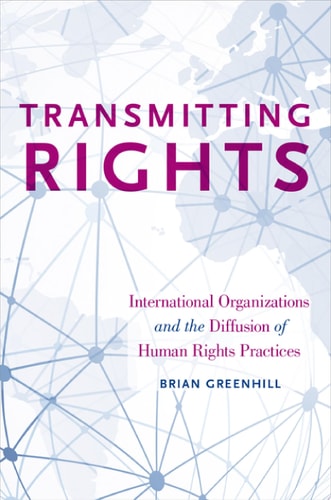
Transmitting Rights
0
0
As an Amazon Associate and affiliate partner, Menrva Books earns from qualifying purchases. Learn more
Author Description
When Considering The Structures That Drive The Global Diffusion Of Human Rights Norms, Brian Greenhill Argues That We Need To Look Beyond Institutions That Are Explicitly Committed To Human Rights And Instead Focus On The Dense Web Of International Government Organizations (igos)-some Big, Some Small; Some Focused On Human Rights; Some Not-that Has Arisen In The Last Two Generations. While Most Of These Organizations Have No Direct Connection To Human Rights Issues, Their Participation In Broader Igo Networks Has Important Implications For The Human Rights Practices Of Their Member States. Featuring A Rigorous Empirical Analysis, Transmitting Rights Shows That Countries Tend To Adopt Similar Human Rights Practices To Those Of Their Igo Partners, Whether For Better Or Worse. Greenhill Argues That Igos Constitute A Tightly-woven Fabric Of Ties Between States And That This Network Provides An Important Channel Through Which States Can Influence The Behavior Of Others. Indeed, His Analysis Suggests That A Policy Of Isolating Rogue States Is Probably Self-defeating Given That This Will Reduce Their Exposure To Some Of The More Positive Igo-based Influences On Their Human Rights. Greenhill's Analysis Of The Role Of Igos In Rights Diffusion Will Not Only Increase Our Understanding Of The International Politics Of Human Rights; It Will Also Reshape How We Think About The Role Of International Institutions In World Politics.
Menrva's Summary
THE THESIS
How do international government organizations (IGOs) influence the diffusion of human rights practices among member states? Brian Greenhill, a scholar of international relations, posits that the dense, interconnected network of IGOs—regardless of their explicit human rights mandates—serves as a primary mechanism for the spread of state behaviors. By analyzing global institutional ties, he argues that states adopt human rights practices similar to those of their IGO partners, suggesting that engagement is more effective than isolation in shaping state conduct.
THE SCOPE MAP
What You Will Find
- Empirical analysis of international government organization networks over the last two generations.
- A framework for understanding how non-human-rights-focused organizations contribute to rights diffusion.
- Quantitative evidence regarding the correlation between IGO membership and state human rights practices.
Scope Limits
- The study focuses primarily on the structural influence of IGO networks rather than the internal domestic political processes of individual states.
- It does not provide a comprehensive history of every specific human rights treaty or organization.
THE AUTHORITY PERSPECTIVE
Experts in international relations recognize this work as a significant contribution to the study of institutional influence on state behavior. Readers frequently note the academic density of the prose and the rigorous statistical methodology employed to support the author's claims.
Page Count:
240
Publication Date:
2015-01-01
Publisher:
Oxford University Press
ISBN-10:
0190271655
ISBN-13:
9780190271657
Human rights
International relations
Sociology
Community Tags
Similar Books