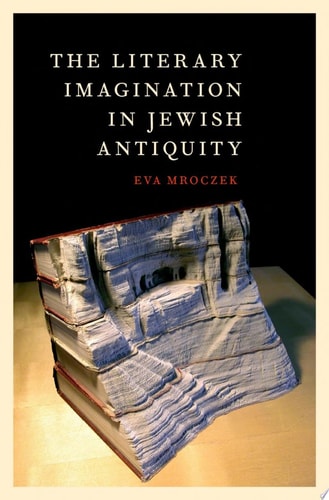
The Literary Imagination in Jewish Antiquity
0
0
As an Amazon Associate and affiliate partner, Menrva Books earns from qualifying purchases. Learn more
Author Description
Winner of the 2017 Manfred Lautenschlaeger Award for Theological PromiseWinner of the 2017 The George A. and Jean S. DeLong Book History Book PrizeThe discovery of the Dead Sea Scrolls revealed a world of early Jewish writing larger than the Bible, from multiple versions of biblical texts to "revealed" books not found in our canon. Despite this diversity, the way we read Second Temple Jewish literature remains constrained by two anachronistic categories: a theological one, "Bible," and a bibliographic one,"book." The Literary Imagination in Jewish Antiquity suggests ways of thinking about how Jews understood their own literature before these categories had emerged.In many Jewish texts, there is an awareness of a vast tradition of divine writing found in multiple locations that is only partially revealed in available scribal collections. Ancient heroes such as David are imagined not simply as scriptural authors, but as multidimensional characters who come to be known as great writers who are honored as founders of growing textual traditions. Scribes recognize the divine origin of texts such as Enoch literature and other writings revealed to ancient patriarchs, which present themselves not as derivative of the material that we now call biblical, but prior to it. Sacred writing stretches back to the dawn of time, yet new discoveries are always around the corner.Using familiar sources such as the Psalms, Ben Sira, and Jubilees, Eva Mroczek tells an unfamiliar story about sacred writing not bound in a Bible. In listening to the way ancient writers describe their own literature-rife with their own metaphors and narratives about writing-The Literary Imagination in Jewish Antiquity also argues for greater suppleness in our own scholarly imagination, no longer bound by modern canonical and bibliographic assumptions.
Menrva's Summary
THE THESIS
This work investigates how ancient Jewish writers conceptualized their own literature before the modern imposition of the categories of 'Bible' and 'book'. Eva Mroczek, a scholar of early Jewish literature, utilizes primary source analysis of Second Temple texts to argue that ancient scribes viewed sacred writing as a vast, ongoing, and divine tradition rather than a fixed, closed canon. She challenges contemporary scholars to move beyond anachronistic bibliographic assumptions to better understand the fluid nature of ancient textual authority.
THE SCOPE MAP
What You Will Find
- Analysis of Second Temple Jewish literature including Psalms, Ben Sira, and Jubilees
- Examination of the role of ancient figures like David as multidimensional literary characters
- Theoretical framework for understanding 'revealed' books and divine writing traditions
Scope Limits
- The study does not provide a comprehensive history of all Second Temple texts
- It does not attempt to reconstruct a singular, definitive history of the biblical canon
THE AUTHORITY PERSPECTIVE
Scholars and critics recognize this text as a significant intervention in the field of biblical studies, frequently noting its success in deconstructing modern biases regarding canonization. Experts highlight the work as a sophisticated, nuanced contribution that forces a re-evaluation of how we categorize ancient religious literature.
Page Count:
282
Publication Date:
2016-05-30
Publisher:
Oxford University Press
ISBN-10:
0190279834
ISBN-13:
9780190279837
Religion
History
Categories
Jewish Studies
Kindle eBooks
Judaism
Jews
Bible Study
Literary Criticism
Ancient History
Kindle Store
Community Tags
Other Editions(2)

Similar Books


Reader Comments
Share Your Thoughts
No comments yet. Be the first to share your thoughts!