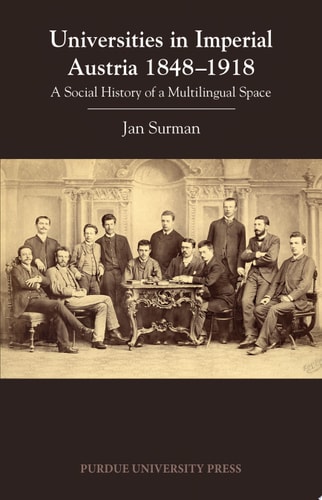
Universities in Imperial Austria 1848–1918: A Social History of a Multilingual Space
0
0
As an Amazon Associate and affiliate partner, Menrva Books earns from qualifying purchases. Learn more
Author Description
Combining history of science and a history of universities with the new imperial history, Universities in Imperial Austria 1848–1918: A Social History of a Multilingual Space by Jan Surman analyzes the practice of scholarly migration and its lasting influence on the intellectual output in the Austrian part of the Habsburg Empire. The Habsburg Empire and its successor states were home to developments that shaped Central Europe's scholarship well into the twentieth century. Universities became centers of both state- and nation-building, as well as of confessional resistance, placing scholars if not in conflict, then certainly at odds with the neutral international orientation of academe. By going beyond national narratives, Surman reveals the Empire as a state with institutions divided by language but united by legislation, practices, and other influences. Such an approach allows readers a better view to how scholars turned gradually away from state-centric discourse to form distinct language communities after 1867; these influences affected scholarship, and by examining the scholarly record, Surman tracks the turn. Drawing on archives in Austria, the Czech Republic, Poland, and Ukraine, Surman analyzes the careers of several thousand scholars from the faculties of philosophy and medicine of a number of Habsburg universities, thus covering various moments in the history of the Empire for the widest view. Universities in Imperial Austria 1848–1918 focuses on the tension between the political and linguistic spaces scholars occupied and shows that this tension did not lead to a gradual dissolution of the monarchy's academia, but rather to an ongoing development of new strategies to cope with the cultural and linguistic multitude.
Menrva's Summary
THE THESIS
This book investigates the complex social and linguistic dynamics within universities in the Austrian part of the Habsburg Empire between 1848 and 1918. Jan Surman, drawing on extensive archival research across multiple countries, analyzes the practice of scholarly migration and its impact on intellectual output. The work explores how universities served as centers for state- and nation-building, often in tension with the international orientation of academia. By moving beyond national narratives, Surman reveals an empire whose institutions were divided by language but unified by overarching legislation and practices, charting the gradual formation of distinct language communities and the strategies scholars employed to navigate this multilingual environment.
THE SCOPE MAP
- Analysis of scholarly migration and its influence on intellectual output in the Habsburg Empire.
- Examination of universities as centers of state
- and nation-building, and confessional resistance.
- Exploration of the Habsburg Empire as a state with institutions divided by language but united by legislation and practices.
- Tracking the shift from state-centric discourse to the formation of distinct language communities after 1867.
- Analysis of the careers of several thousand scholars from philosophy and medicine faculties.
- Coverage of various moments in the Empire's history for a comprehensive view.
- Focus on the tension between political and linguistic spaces occupied by scholars.
- Demonstration of how this tension led to the development of new strategies for managing cultural and linguistic diversity.
THE AUTHORITY PERSPECTIVE
This book is recognized for its interdisciplinary approach, combining the history of science, university history, and imperial history. It offers a nuanced perspective on the Habsburg Empire's intellectual landscape, moving beyond simplistic national narratives to highlight the complexities of a multilingual academic space. The research is noted for its extensive use of archival materials from Austria, the Czech Republic, Poland, and Ukraine, providing a broad and detailed social history of scholars and institutions during a pivotal period. The work is considered a significant contribution to understanding the development of Central European scholarship.
Page Count:
460
Publication Date:
2018-12-15
Publisher:
Purdue University Press
ISBN-10:
1612495621
ISBN-13:
9781612495620
History
Non-Fiction
Linguistics
Higher Education
Social History
Central Europe
Community Tags
Similar Books