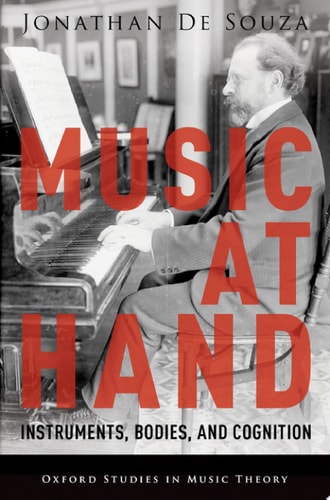
Music at Hand: Instruments, Bodies, and Cognition
0
0
As an Amazon Associate and affiliate partner, Menrva Books earns from qualifying purchases. Learn more
Author Description
From prehistoric bone flutes to pipe organs to digital synthesizers, instruments have been important to musical cultures around the world. Yet, how do instruments affect musical organization? And how might they influence players' bodies and minds?Music at Hand explores these questions with a distinctive blend of music theory, psychology, and philosophy. Practicing an instrument, of course, builds bodily habits and skills. But it also develops connections between auditory and motor regions in a player's brain. These multi-sensory links are grounded in particular instrumental interfaces. They reflect the ways that an instrument converts action into sound, and the ways that it coordinates physical and tonal space. Ultimately, these connections can shape listening, improvisation, or composition. This means that pianos, guitars, horns, and bells are not simply tools for making notes. Such technologies, as creative prostheses, also open up possibilities for musical action, perception, and cognition.Throughout the book, author Jonathan De Souza examines diverse musical case studies-from Beethoven to blues harmonica, from Bach to electronic music-introducing novel methods for the analysis of body-instrument interaction. A companion website supports these analytical discussions with audiovisual examples, including motion-capture videos and performances by the author. Written in lucid prose, Music at Hand offers substantive insights for music scholars, while remaining accessible to non-specialist readers. This wide-ranging book will engage music theorists and historians, ethnomusicologists, organologists, composers, and performers-but also psychologists, philosophers, media theorists, and anyone who is curious about how musical experience is embodied and conditioned by technology.
Menrva's Summary
THE THESIS
This book investigates how musical instruments function as cognitive and physical extensions of the performer, shaping musical perception, composition, and improvisation. Jonathan De Souza, a scholar in music theory, synthesizes perspectives from psychology, philosophy, and organology to argue that instruments are not merely passive tools. He proposes a framework where instruments act as creative prostheses, mediating the relationship between human motor action and auditory output through specific technological interfaces.
THE SCOPE MAP
What You Will Find
- Analysis of body-instrument interaction across diverse musical traditions and technologies.
- Theoretical frameworks linking auditory and motor brain regions to instrumental interfaces.
- Case studies ranging from historical classical works by Bach and Beethoven to blues harmonica and electronic music.
- Integration of audiovisual examples and motion-capture data via a companion website.
Scope Limits
- The text does not provide a comprehensive history of every musical instrument ever created.
- It does not serve as a practical instructional manual for learning to play specific instruments.
THE AUTHORITY PERSPECTIVE
Scholars and music theorists recognize this work as a significant contribution to the study of embodied cognition and the philosophy of musical performance. Readers frequently note that the prose remains accessible to non-specialists while providing enough technical depth to satisfy academic researchers in musicology and psychology.
Page Count:
205
Publication Date:
2017-01-01
Publisher:
Oxford University Press
ISBN-10:
0190271132
ISBN-13:
9780190271138
Music Philosophy
Music theory
Organology
Humanities
Musicology
Music
Community Tags
Similar Books