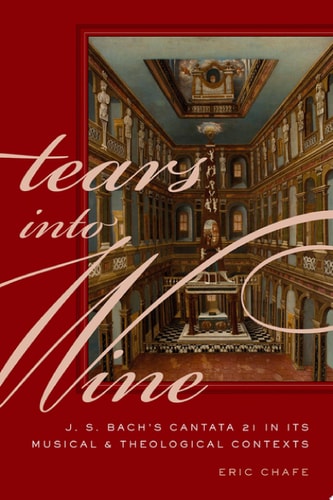
Tears into Wine: J. S. Bach's Cantata 21 in its Musical and Theological Contexts
0
0
As an Amazon Associate and affiliate partner, Menrva Books earns from qualifying purchases. Learn more
Author Description
In 1714, the 29 year-old Johann Sebastian Bach was promoted to the position of concertmaster at the ducal court of Weimar. This post required him for the first time in his already established career to produce a regular stream of church cantatas-one cantata every four weeks. Among the most significant works of this period is Ich hatte viel Bekümmernis in meinem Herzen (Cantata 21). Generally known in English as "I had much affliction," Cantata 21 draws from several psalms and the Book of Revelations and offers a depiction of the spiritual ascent of the soul from intense tribulation to joy and exaltation. Although widely performed and loved by musicians, Cantata 21 has endured much criticism from scholars and critics who claim that the piece lacks organizational clarity and stylistic coherence. In Tears into Wine, renowned Bach scholar Eric Chafe challenges the scholarly consensus, arguing that Cantata 21 is an exceptionally carefully designed work, and that it displays a convergence of musical structure and theological purpose that is paradigmatic of Bach's sacred work as a whole.Drawing on a wide range of Lutheran theological writing, Chafe shows that Cantata 21 reaches beyond the scope of the individual liturgical occasion to voice a breadth of meaning that encompasses much of the core of Lutheran thought. Chafe artfully demonstrates that instead of simply presenting a musical depiction of the soul's journey from sorrow to bliss, Cantata 21 expresses the various stages of God's revelation and their impact on the believing soul. As a result, Chafe reveals that Cantata 21 has a formal design that mirrors Lutheran belief in unfolding revelation, with the final movement representing the work's "crown"--the goal toward which all of the earlier movements are directed. Complete with full text translations of the cantata and the liturgical readings that would have accompanied it at the first performance, Tears into Wine is a monumental book that is ideally suited for Bach
Menrva's Summary
THE THESIS
Does J. S. Bach's Cantata 21 possess a coherent organizational structure, or is it a disjointed work as critics have historically suggested? Eric Chafe, a prominent scholar in the field of Bach studies, utilizes a rigorous analysis of Lutheran theological texts and musical composition to argue that the cantata is a meticulously crafted piece where musical form directly mirrors the theological progression of the soul's revelation.
THE SCOPE MAP
What You Will Find
- Detailed analysis of the musical structure of Cantata 21 in relation to its liturgical context.
- Examination of 18th-century Lutheran theological writings and their influence on Bach's compositional choices.
- Full text translations of the cantata and the associated liturgical readings from its first performance.
Scope Limits
- The study focuses primarily on Cantata 21 and does not provide a comprehensive survey of Bach's entire cantata output.
- The analysis is limited to the specific theological framework of the Weimar court period.
THE AUTHORITY PERSPECTIVE
Experts recognize this work as a significant contribution to Bach scholarship that successfully refutes long-standing criticisms regarding the cantata's structural integrity. Readers frequently note the academic density of the prose, which requires a strong background in both music theory and historical theology to fully appreciate.
Page Count:
620
Publication Date:
2015-01-01
Publisher:
Oxford University Press
ISBN-10:
0190272961
ISBN-13:
9780190272968
Humanities
Theology
Musicology
Music History
Community Tags
Similar Books