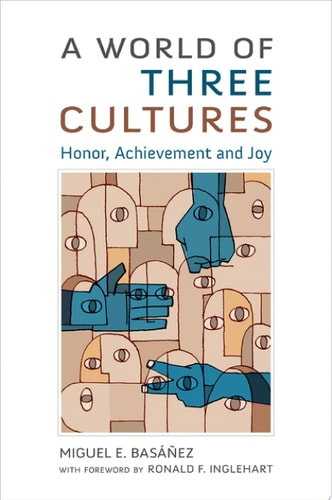
A World of Three Cultures: Honor, Achievement and Joy
0
0
As an Amazon Associate and affiliate partner, Menrva Books earns from qualifying purchases. Learn more
Author Description
In this book, Miguel Basáñez presents a provocative look at the impact of culture on global development. Drawing on data from governments, NGOs, the World Values Survey and more addressing over one hundred countries, he argues that values, as the "building blocks" of culture, are directly related to the speed with which social, cultural and economic development occurs. Basáñez utilizes quantitative survey data to delineate three cultural hyperclusters across the globe: cultures of honor, which prioritize political authority; cultures of achievement, which emphasize economic advancement; and cultures of joy, which focus on social interactions. According to Basáñez, these cultures evolved chronologically, mirroring the development of agrarian, industrial and service societies.He argues that a country's developmental path is profoundly influenced by its people's values and culture, as crystallized through its formal and informal governing institutions. Culture is passed down over generations through families, schools, the media, religious institutions, leadership, and the law. Although culture and values are in a permanent state of evolution, leaders and policymakers can also push cultural change in order to promote desirable goals such as economic growth, democratization, and equality. Over the course of the book, Basáñez introduces two new measures of development: the Objective Development Index (which blends rubrics such as health, education, income, gender equality, political rights and civil liberties, and economic inequality) and the Subjective Development Index (which uses responses to the World Values Survey to classify countries according to their values).
Menrva's Summary
THE THESIS
How do the underlying cultural values of a society dictate its trajectory toward economic, political, and social development? Miguel E. Basáñez, a scholar with extensive experience in international development and survey research, posits that values serve as the foundational architecture of culture. By synthesizing vast datasets from the World Values Survey and various international organizations, he argues that the speed and nature of a nation's progress are inextricably linked to its dominant cultural orientation.
THE SCOPE MAP
What You Will Find
- A classification system for three primary cultural hyperclusters: honor, achievement, and joy.
- The introduction of the Objective Development Index and the Subjective Development Index as analytical tools.
- An examination of how institutions like family, media, and law transmit cultural values across generations.
Scope Limits
- The text does not provide a prescriptive manual for immediate policy implementation in specific local contexts.
- It does not account for every micro-cultural variation within the identified hyperclusters.
THE AUTHORITY PERSPECTIVE
Experts frequently cite this work as a significant contribution to the quantitative study of cultural values and their impact on national development. Readers often note the academic density of the prose, which requires a foundational understanding of sociological and economic metrics to fully appreciate the author's arguments.
Page Count:
388
Publication Date:
2015-01-01
Publisher:
Oxford University Press
ISBN-10:
019027039X
ISBN-13:
9780190270391
Economics
Comparative Politics
Sociology
Global Studies
Community Tags
Similar Books