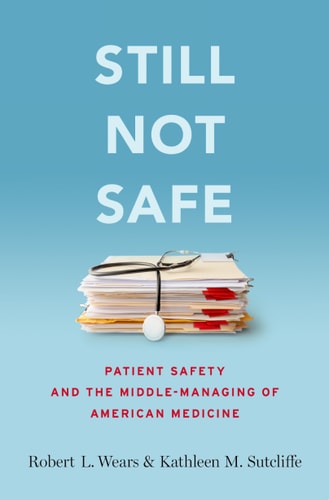
Still Not Safe
0
0
As an Amazon Associate and affiliate partner, Menrva Books earns from qualifying purchases. Learn more
Author Description
The term patient safety rose to popularity in the late nineties, as the medical community -- in particular, physicians working in nonmedical and administrative capacities -- sought to raise awareness of the tens of thousands of deaths in the US attributed to medical errors each year. But what was causing these medical errors? And what made these accidents to rise to epidemic levels, seemingly overnight? Still Not Safe is the story of the rise of the patient-safety movement -- and how an epidemic of medical errors was derived from a reality that didn't support such a characterization. Physician Robert Wears and organizational theorist Kathleen Sutcliffe trace the origins of patient safety to the emergence of market trends that challenged the place of doctors in the larger medical ecosystem: the rise in medical litigation and physicians' aversion to risk; institutional changes in the organization and control of healthcare; and a bureaucratic movement to rationalize medical practice -- to make a hospital run like a factory. If these social factors challenged the place of practitioners, then the patient-safety movement provided a means for readjustment. In spite of relatively constant rates of medical errors in the preceding decades, the epidemic was announced in 1999 with the publication of the Institute of Medicine report To Err Is Human; the reforms that followed came to be dominated by the very professions it set out to reform. Weaving together narratives from medicine, psychology, philosophy, and human performance, Still Not Safe offers a counterpoint to the presiding, doctor-centric narrative of contemporary American medicine. It is certain to raise difficult, important questions around the state of our healthcare system -- and provide an opening note for other challenging conversations.
Menrva's Summary
THE THESIS
This book investigates the origins and sociological drivers of the patient-safety movement, questioning whether the perceived epidemic of medical errors was a genuine crisis or a constructed response to institutional shifts.
Authors Robert Wears, a physician, and Kathleen Sutcliffe, an organizational theorist, utilize a multidisciplinary framework to analyze the 1999 Institute of Medicine report, To Err Is Human. They argue that the movement was less a response to a sudden spike in errors and more a reaction to market pressures, medical litigation, and the bureaucratic rationalization of hospital environments. By examining the intersection of medicine, psychology, and organizational behavior, the authors challenge the prevailing narrative regarding the state of contemporary American healthcare.
THE SCOPE MAP
What You Will Find
- Historical analysis of the patient-safety movement post-1999
- Organizational theory applied to hospital management and medical practice
- Examination of market trends, litigation, and risk aversion in medicine
- Synthesis of psychological and philosophical perspectives on human performance
Scope Limits
- Does not provide a clinical guide for reducing specific medical errors
- Does not offer a comprehensive history of all medical malpractice legislation
THE AUTHORITY PERSPECTIVE
Experts and readers frequently note the academic density of the prose, which draws heavily from organizational theory and sociology. The text is widely recognized as a critical, counter-narrative contribution to the study of healthcare systems and institutional reform.
Page Count:
256
Publication Date:
2019-01-01
Publisher:
Oxford University Press
ISBN-10:
0190271272
ISBN-13:
9780190271275
Sociology of Medicine
Healthcare Policy
MEDICAL History
Organizational Theory
Public Health
Community Tags
Similar Books