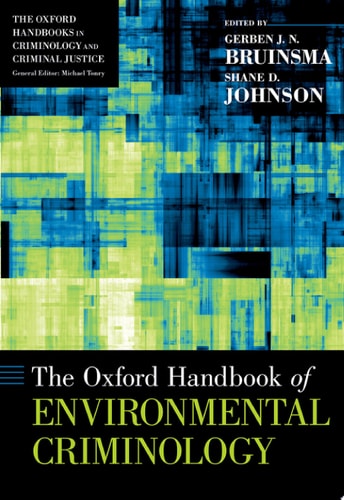
The Oxford Handbook of Environmental Criminology
0
0
As an Amazon Associate and affiliate partner, Menrva Books earns from qualifying purchases. Learn more
Author Description
The Study Of How The Environment, Local Geography, And Physical Locations Influence Crime Has A Long History That Stretches Across Many Research Traditions. These Include The Neighborhood Effects Approach Developed In The 1920s, The Criminology Of Place, And A Newer Approach That Attends To The Perception Of Crime In Communities. Aided By New Technologies And Improved Data-reporting In Recent Decades, Research In Environmental Criminology Has Developed Rapidly Within Each Of These Approaches. Yet Research In The Subfield Remains Fragmented And Competing Theories Are Rarely Examined Together. The Oxford Handbook Of Environmental Criminology Takes A Unique Approach And Synthesizes The Contributions Of Existing Methods To Better Integrate The Subfield As A Whole. Gerben J.n. Bruinsma And Shane D. Johnson Have Assembled A Cast Of Top Scholars To Provide An In-depth Source For Understanding How And Why Physical Setting Can Influence The Emergence Of Crime, Affect The Environment, And Impact Individual Or Group Behavior. The Contributors Address How Changes In The Environment, Global Connectivity, And Technology Provide More Criminal Opportunities And New Ways Of Committing Old Crimes. They Also Explore How Crimes Committed In Countries With Distinct Cultural Practices Like China And West Africa Might Lead To Different Spatial Patterns Of Crime. This Is A State-of-the-art Compendium On Environmental Criminology That Reflects The Diverse Research And Theory Developed Across The Western World.
Menrva's Summary
THE THESIS
This volume investigates the complex relationship between physical environments, local geography, and the emergence of criminal activity. Editors Gerben J. N. Bruinsma and Shane D. Johnson curate contributions from leading scholars to synthesize fragmented research traditions, including neighborhood effects and the criminology of place, into a cohesive framework that addresses how modern technology and global connectivity alter criminal opportunities.
THE SCOPE MAP
What You Will Find
- Analysis of historical research traditions such as the 1920s neighborhood effects approach.
- Examination of how physical settings influence individual and group behavior.
- Comparative studies on spatial patterns of crime across diverse cultural contexts like China and West Africa.
Scope Limits
- The text focuses primarily on research and theory developed within the Western world.
- It does not provide a manual for law enforcement tactical operations or specific crime prevention implementation strategies.
THE AUTHORITY PERSPECTIVE
Experts identify this handbook as a comprehensive compendium that successfully bridges the gap between competing theories in the field. Readers frequently note the academic density of the prose, making it a primary resource for researchers and graduate students studying the spatial dimensions of crime.
Page Count:
904
Publication Date:
2018-01-01
Publisher:
Oxford University Press
ISBN-10:
0190279710
ISBN-13:
9780190279714
Sociology
Criminology
urban planning
Community Tags
Similar Books