Origins of Intelligence
0
0
As an Amazon Associate and affiliate partner, Menrva Books earns from qualifying purchases. Learn more
Author Description
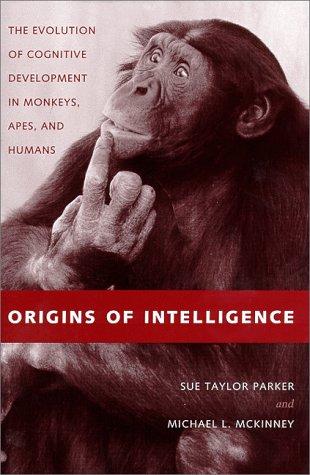
Since Darwin's time, comparative psychologists have searched for a good way to compare cognition in humans and nonhuman primates. In Origins of Intelligence, Sue Parker and Michael McKinney offer such a framework and make a strong case for using human development theory (both Piagetian and neo-Piagetian) to study the evolution of intelligence across primate species. Their approach is comprehensive, covering a broad range of social, symbolic, physical, and logical domains, which fall under the all-encompassing and much-debated term intelligence.
Menrva's Summary
THE THESIS
This book proposes a novel framework for understanding the evolution of intelligence by applying human developmental theories to primate cognition. Sue Taylor Parker and Michael McKinney argue that human developmental theories, specifically Piagetian and neo-Piagetian models, provide a robust method for comparing intelligence across primate species, a long-standing challenge in comparative psychology since Darwin's era. Their comprehensive approach examines a wide array of cognitive domains, including social, symbolic, physical, and logical aspects, all encompassed within the broad and often debated concept of intelligence.
THE SCOPE MAP
- A framework for comparing primate and human intelligence based on human developmental theory.
- Application of Piagetian and neo-Piagetian developmental models to evolutionary studies.
- Analysis of social, symbolic, physical, and logical domains of intelligence.
- A comprehensive overview of intelligence across various primate species.
THE AUTHORITY PERSPECTIVE
The book offers a significant theoretical contribution to the study of intelligence evolution, proposing a novel comparative framework. Its reliance on human developmental psychology to analyze primate cognition is a distinctive approach that challenges existing methodologies. The work is likely to be of interest to specialists in comparative psychology, primatology, and evolutionary anthropology seeking to understand the roots of cognitive abilities.
Page Count:
404
Publication Date:
1999-01-01
ISBN-10:
0801860121
Non-Fiction
Animals
Psychology
Science
Evolutionary Psychology
Primatology
Comparative Psychology
Community Tags
Similar Books