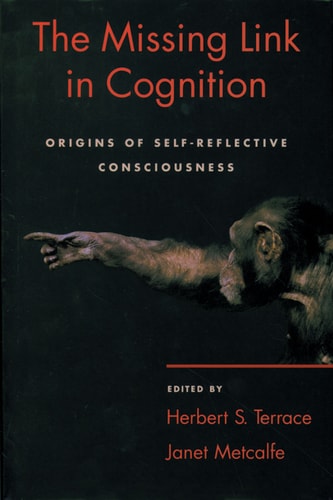
The Missing Link in Cognition: Origins of Self-Reflective Consciousness
0
0
As an Amazon Associate and affiliate partner, Menrva Books earns from qualifying purchases. Learn more
Author Description
Are humans unique in having self-reflective consciousness? Or can precursors to this central form of human consciousness be found in non-human species? The Missing Link in Cognition brings together a diverse group of researchers who have been investigating this question from a variety of perspectives, including the extent to which non-human primates, and, indeed, young children, have consciousness, a sense of self, thought process, metacognitions, and representations. Some of the participants--Kitcher, Higgins, Nelson, and Tulving--argue that these types of cognitive abilities are uniquely human, whereas others--Call, Hampton, Kinsbourne, Menzel, Metcalfe, Schwartz, Smith, and Terrace--are convinced that at least the precursors to self-reflective consciousness exist in non-human primates.Their debate focuses primarily on the underpinnings of consciousness. Some of the participants believe that consciousness depends on representational thought and on the mental manipulation of such representations. Is representational thought enough to ensure consciousness, or does one need more? If one needs more, exactly what is needed? Is reflection upon the representations, that is, metacognition, the link? Does a realization of the contingencies, that is, "knowing that," in Gilbert Ryle's terminology, ensure that a person or an animal is conscious? Is true episodic memory needed for consciousness, and if so, do any animals have it? Is it possible to have episodic memory or, indeed, any self-reflective processing, without language?Other participants believe that consciousness is inextricably intertwined with a sense of self or self-awareness. From where does this sense of self or self-awareness arise? Some of the participants believe that it develops only through the use of language and the narrative form. If it does develop in this way, what about claims of a sense of self or self-awareness in non-human animals? Others believe that the autobiographical record implied by episodic
Menrva's Summary
THE THESIS
This volume investigates whether self-reflective consciousness is a uniquely human trait or if precursors to this cognitive state exist in non-human species. Editors Herbert S. Terrace and Janet Metcalfe compile a series of essays from leading researchers in psychology and cognitive science to examine the intersection of metacognition, representational thought, and self-awareness. The text presents a structured debate between scholars who argue for human exclusivity in these cognitive domains and those who identify evidence of self-reflective processing in non-human primates.
THE SCOPE MAP
What You Will Find
- Comparative analysis of cognitive abilities in primates and young children
- Theoretical frameworks regarding representational thought and episodic memory
- Discussions on the necessity of language for the development of a sense of self
- Philosophical inquiries into the nature of 'knowing that' and metacognitive awareness
Scope Limits
- The text does not provide a definitive, singular conclusion to the debate
- It does not cover neurobiological mapping of consciousness in detail
THE AUTHORITY PERSPECTIVE
Experts recognize this collection as a significant contribution to the comparative study of consciousness, noting the high level of academic rigor in the arguments presented. Readers frequently highlight the density of the prose, which is tailored for researchers and advanced students in the cognitive sciences.
Page Count:
374
Publication Date:
2005-01-01
Publisher:
Oxford University Press
ISBN-10:
0190289791
ISBN-13:
9780190289799
Psychology
Philosophy of
Consciousness Studies
Developmental Psychology
Neuroscience
Psychology Comparative
Community Tags
Similar Books


Reader Comments
Share Your Thoughts
No comments yet. Be the first to share your thoughts!