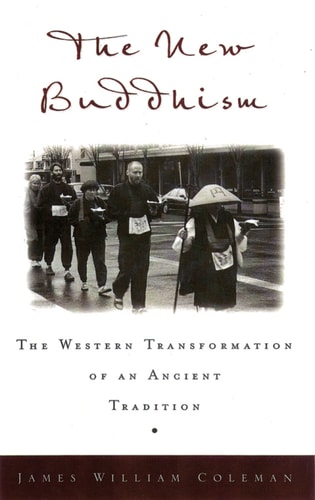
The New Buddhism: The Western Transformation of an Ancient Tradition
0
0
As an Amazon Associate and affiliate partner, Menrva Books earns from qualifying purchases. Learn more
Author Description
In our multicultural society, faiths formerly seen as exotic have become attractive alternatives for many people seeking more satisfying spiritual lives. This is especially true of Buddhism, which is the focus of constant media attention--thanks at least in part to celebrity converts, major motion pictures, and the popularity of the Dalai Lama. Following this recent trend in the West, author James Coleman argues that a new and radically different form of this ancient faith is emerging. The New Buddhism sheds new light on this recent evolution of Buddhist practice in the West. After briefly recounting the beginnings and spread of Buddhism in the East, Coleman chronicles its reinterpretation by key Western teachers in the nineteenth and twentieth centuries, ranging from the British poet Sir Edwin Arnold to the Beat writer Alan Watts. Turning to the contemporary scene, he finds that Western teachers have borrowed liberally from different Buddhist traditions that never intersect in their original contexts. Men and women practice together as equals; ceremonies and rituals are simpler, more direct, and not believed to have magical effects. Moreover, the new Buddhism has made the path of meditation and spiritual awakening available to everyone, not just an elite cadre of monks. Drawing on interviews with noted teachers and lay practitioners, as well as a survey completed by members of seven North American Buddhist centers, Coleman depicts the colorful variety of new Buddhists today, from dilettantes to devoted students and the dedicated teachers who guide their spiritual progress. He also details the problems that have arisen because of some Western influences--especially with regard to gender roles, sex, and power. Exploring the appeal of this exotic faith in postmodern society and questioning its future in a global consumer culture, The New Buddhism provides a thorough and fascinating guide to Western Buddhism today.
Menrva's Summary
THE THESIS
This book investigates the emergence of a distinct, Westernized form of Buddhism and the sociological implications of its adaptation within a modern, multicultural society. Author James William Coleman, a sociologist, utilizes historical analysis and empirical data to argue that Western practitioners are synthesizing disparate Buddhist traditions into a new, egalitarian, and lay-oriented spiritual framework. He examines how this transformation reflects broader shifts in Western cultural values, particularly regarding gender, authority, and the democratization of meditative practice.
THE SCOPE MAP
What You Will Find
- Historical overview of Buddhism's transmission from Eastern origins to Western contexts.
- Analysis of the influence of 19th and 20th-century figures like Sir Edwin Arnold and Alan Watts.
- Empirical data derived from surveys of seven North American Buddhist centers.
- Examination of contemporary issues including power dynamics, gender roles, and sexual ethics within sanghas.
Scope Limits
- The text focuses primarily on North American developments rather than a global history of Buddhism.
- It does not provide a comprehensive theological manual for traditional Eastern Buddhist practices.
THE AUTHORITY PERSPECTIVE
Scholars and practitioners frequently cite this work as a foundational sociological study of the Western Buddhist movement. Readers note the balance between academic rigor and accessible prose, making it a standard reference for understanding the institutional challenges faced by modern Western sanghas.
Page Count:
269
Publication Date:
2002-01-01
Publisher:
Oxford University Press
ISBN-10:
0190288221
ISBN-13:
9780190288228
Religion
Philosophy
Spirituality
Buddhism
Religious Life
Sociology of Religion
Zen
Western philosophy
Community Tags
Similar Books