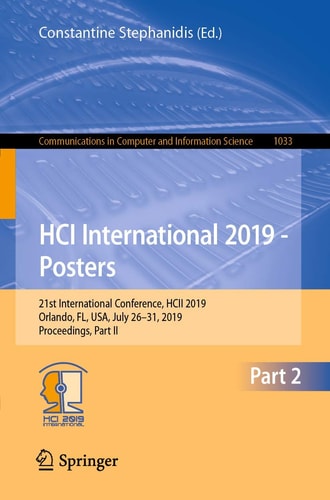
HCI International 2019 - Posters: 21st International Conference, HCII 2019, Orlando, FL, USA, July 26–31, 2019, Proceedings, Part II
0
0
As an Amazon Associate and affiliate partner, Menrva Books earns from qualifying purchases. Learn more
Author Description
The three-volume set CCIS 1032, CCIS 1033, and CCIS 1034 contains the extended abstracts of the posters presented during the 21st International Conference on Human-Computer Interaction, HCII 2019, which took place in Orlando, Florida, in July 2019.The total of 1274 papers and 209 posters included in the 35 HCII 2019 proceedings volumes was carefully reviewed and selected from 5029 submissions. The 208 papers presented in these three volumes are organized in topical sections as follows: Part I: design, development and evaluation methods and technique; multimodal Interaction; security and trust; accessibility and universal access; design and user experience case studies. Part II:interacting with games; human robot interaction; AI and machine learning in HCI; physiological measuring; object, motion and activity recognition; virtual and augmented reality; intelligent interactive environments. Part III: new trends in social media; HCI in business; learning technologies; HCI in transport and autonomous driving; HCI for health and well-being.
Menrva's Summary
THE THESIS
This volume presents a collection of research posters from the 21st International Conference on Human-Computer Interaction (HCII 2019), focusing on advancements and applications in various HCI domains. The proceedings, divided into three parts, cover a wide spectrum of topics including design methodologies, multimodal interaction, security, accessibility, human-robot interaction, AI and machine learning in HCI, physiological measuring, object recognition, virtual and augmented reality, and intelligent interactive environments. This compilation offers insights into the latest research and development in making technology more usable, accessible, and engaging for humans.
THE SCOPE MAP
- Research on interacting with games and game design principles.
- Studies in human-robot interaction and collaborative robotics.
- Applications of AI and machine learning within HCI contexts.
- Techniques for physiological measuring and biofeedback.
- Methods for object, motion, and activity recognition.
- Developments in virtual and augmented reality interfaces.
- Innovations in intelligent interactive environments and smart spaces.
THE AUTHORITY PERSPECTIVE
This collection of posters from HCII 2019 serves as a snapshot of current research trends in human-computer interaction. The broad range of topics, from AI and robotics to VR/AR and accessibility, indicates a field actively exploring diverse applications and methodologies. The inclusion of physiological measuring and object recognition highlights a growing interest in more nuanced and data-driven approaches to understanding user interaction. The organization into topical sections suggests a structured approach to disseminating research findings across specialized sub-disciplines within HCI.
Page Count:
554
Publication Date:
2019-07-06
Publisher:
Springer International Publishing
ISBN-10:
3030235270
ISBN-13:
9783030235277
Non-Fiction
Science & Technology
Augmented Reality
Accessibility
Robotics
Machine Learning
Community Tags
Similar Books