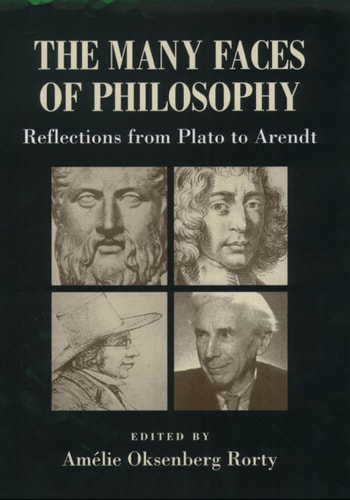
The Many Faces of Philosophy: Reflections from Plato to Arendt
0
0
As an Amazon Associate and affiliate partner, Menrva Books earns from qualifying purchases. Learn more
Author Description
Philosophy is a dangerous profession, risking censorship, prison, even death. And no wonder: philosophers have questioned traditional pieties and threatened the established political order. Some claimed to know what was thought unknowable; others doubted what was believed to be certain. Some attacked religion in the name of science; others attacked science in the name of mystical poetry; some served tyrants; others were radical revolutionaries.This historically based collection of philosophers' reflections--the letters, journals, prefaces that reveal their hopes and hesitations, their triumphs and struggles, their deepest doubts and convictions--allow us to witness philosophical thought-in-process. It sheds light on the many--and conflicting--aims of philosophy: to express skepticism or overcome it, to support theology or attack it, to develop an ethical system or reduce it to practical politics. As their audiences differed, philosophers experimented with distinctive rhetorical strategies, writing dialogues, meditations, treatises, aphorisms. Ranging from Plato to Hannah Arendt, with contributions from 44 philosophers (Augustine, Maimonides, AlGhazali, Descartes, Pascal, Leibniz, Voltaire, Rousseau, Hobbes, Hume, Kant, Nietzsche, Kierkegaard, Wittgenstein, among others) this remarkable collection documents philosophers' claim that they change as well as understand the world. In her introductory essay, "Witnessing Philosophers," Amelie Rorty locates philosophers' reflections in the larger context of the many facets of their other activities and commitments.
Menrva's Summary
THE THESIS
This collection investigates the core question of what motivates philosophical inquiry and how philosophers have historically navigated the risks and responsibilities of their profession. Amélie Oksenberg Rorty, a distinguished scholar of philosophy, curates a selection of primary source reflections—including letters, journals, and prefaces—to demonstrate how thinkers from Plato to Arendt have grappled with the tension between understanding the world and attempting to change it. By examining these personal accounts, the book argues that philosophy is not a static discipline but a dynamic, often dangerous, practice shaped by diverse rhetorical strategies and political commitments.
THE SCOPE MAP
What You Will Find
- A curated anthology of reflections from 44 major philosophers spanning from antiquity to the 20th century.
- An introductory essay by Rorty that contextualizes the personal writings within the broader professional lives of the thinkers.
- Primary source material including personal correspondence, private journals, and formal prefaces.
Scope Limits
- The text does not provide a comprehensive history of philosophical doctrines or a systematic survey of every major school of thought.
- It focuses primarily on the personal and professional motivations of the philosophers rather than an exhaustive analysis of their technical arguments.
THE AUTHORITY PERSPECTIVE
Scholars and students of philosophy frequently cite this collection as a valuable resource for understanding the human element behind canonical texts. Readers often note that the prose is accessible to those interested in intellectual history while providing enough depth to serve as a supplemental text for advanced academic study.
Page Count:
544
Publication Date:
2003-01-01
Publisher:
Oxford University Press
ISBN-10:
0190285389
ISBN-13:
9780190285388
Philosophy
Non-Fiction
English
History & Surveys
Essays
Biography Autobiography
Intellectual History
English & College Success
Philosophy history
Community Tags
Similar Books