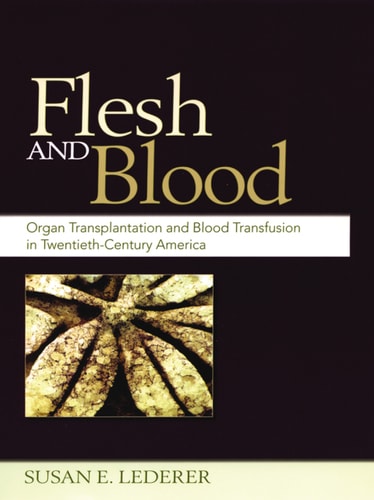
Flesh and Blood: Organ Transplantation and Blood Transfusion in 20th Century America
0
0
As an Amazon Associate and affiliate partner, Menrva Books earns from qualifying purchases. Learn more
Author Description
Organ transplantation is one of the most dramatic interventions in modern medicine. Since the 1950s thousands of people have lived with 'new' hearts, kidneys, lungs, corneas, and other organs and tissues transplanted into their bodies. From the beginning, though, there was simply a problem: surgeons often encountered shortages of people willing and able to give their organs and tissues. To overcome this problem, they often brokered financial arrangements. Yet an ethic of gift exchange coexisted with the 'commodification of the body'. The same duality characterized the field of blood transfusion, which was essential to the development of modern surgery. This book will be the first to bring together the histories of blood transfusion and organ transplantation. It will show how these two fields redrew the lines between self and non-self, the living and the dead, and humans and animals. Drawing on newspapers, magazines, legal cases, films and the papers and correspondence of physicians and surgeons, Lederer will challenge the assumptions of some bioethicists and policymakers that popular fears about organ transplantation necessarily reflect timeless human concerns and preoccupations with the body. She will show how notions of the body- intact, in parts, living and dead- are shaped by the particular culture in which they are embedded.
Menrva's Summary
THE THESIS
This book investigates how the cultural and social history of organ transplantation and blood transfusion in 20th-century America shaped modern medical practices and perceptions of the human body. Susan E. Lederer, a historian of medicine, utilizes a wide array of primary sources—including legal records, media archives, and personal physician correspondence—to argue that medical practices regarding the body are not driven by timeless human fears, but are instead constructed by specific cultural contexts. She examines the tension between the altruistic ideal of gift exchange and the reality of body commodification in surgical history.
THE SCOPE MAP
What You Will Find
- Historical analysis of the development of organ transplantation and blood transfusion since the 1950s.
- Examination of the ethical and financial frameworks surrounding organ procurement.
- Cultural critique of how society defines the boundaries between self and non-self, and the living and the dead.
Scope Limits
- The text focuses primarily on the American medical context and does not provide a global history of these procedures.
- It does not serve as a technical manual for surgical techniques or clinical procedures.
THE AUTHORITY PERSPECTIVE
Scholars and historians of medicine frequently cite this work for its rigorous archival research and its ability to contextualize complex bioethical issues within a broader cultural framework. It is widely regarded as a foundational text for understanding the intersection of medical history and social policy in the United States.
Page Count:
224
Publication Date:
2008-01-01
Publisher:
Oxford University Press
ISBN-10:
0190289775
ISBN-13:
9780190289775
History
Science
Bioethics
Medicine
Medical
Social change
Sociology
20th Century
Allied Health
Community Tags
Similar Books