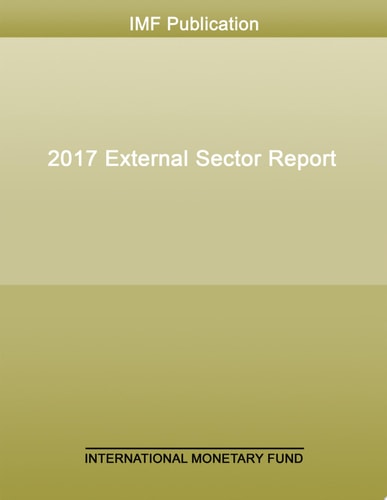
2017 External Sector Report
0
0
As an Amazon Associate and affiliate partner, Menrva Books earns from qualifying purchases. Learn more
Author Description
Global current account imbalances were broadly unchanged in 2016, with minor shifts adding to the reconfiguration under way since 2013. The fall in commodity prices, uneven cyclical recoveries in systemic economies, and differences in policy responses contributed to the rotation of imbalances. Current account surpluses of oil-exporting economies, as a group, shifted from large surpluses to small deficits, while deficits in emerging and developing economies narrowed markedly. At the same time, surpluses and deficits in key advanced economies widened. These trends were generally supported by real exchange rate movements. Overall excess current account imbalances (i.e., deficits or surpluses that deviate from desirable levels) represented about one-third of total global imbalances in 2016, remaining broadly unchanged since 2013, although increasingly concentrated in advanced economies. In particular, excess imbalances narrowed in emerging and developing economies, led by a smaller excess surplus in China and smaller excess deficits in others (Brazil, Indonesia, South Africa, Turkey). This narrowing, however, was accompanied by a widening of excess imbalances in some advanced economies. The persistence of large excess surpluses in several advanced economies (e.g. Germany, Korea, the Netherlands, Singapore, Sweden) remains a distinguishing feature of the constellation of imbalances, an issue that is explored in greater detail in this year’s report. Persistent global excess imbalances suggest that automatic adjustment mechanisms are weak. While the rotation of excess imbalances toward advanced economies—with deficits increasingly concentrated in the United States and United Kingdom—likely entails lower deficit-financing risks in the near term, the increased concentration of deficits in a few economies carries greater risks of disruptive trade policy actions. Diverging stock positions coupled with continued overreliance on demand from debtor countries could also pose risks
Menrva's Summary
THE THESIS
The 2017 External Sector Report investigates the persistence and reconfiguration of global current account imbalances. The report details how these imbalances, broadly unchanged in 2016, have been reshaped by factors including commodity price fluctuations, uneven economic recoveries, and diverse policy responses. It highlights a rotation of imbalances, with oil-exporting economies shifting from surplus to deficit, and emerging economies narrowing their deficits, while key advanced economies saw their surpluses and deficits widen. The analysis further explores the concentration of excess imbalances within advanced economies and the potential risks associated with persistent imbalances and trade policy actions.
THE SCOPE MAP
- Analysis of global current account imbalances in 2016 and their reconfiguration since 2013.
- Impact of commodity price falls, cyclical recoveries, and policy responses on imbalances.
- Shifts in current account balances for oil-exporting economies and emerging/developing economies.
- Widening surpluses and deficits in key advanced economies.
- Measurement and concentration of excess current account imbalances, particularly in advanced economies.
- Examination of persistent excess surpluses in countries like Germany, Korea, the Netherlands, Singapore, and Sweden.
- Discussion of weak automatic adjustment mechanisms and risks from concentrated deficits and potential trade policy actions.
THE AUTHORITY PERSPECTIVE
The International Monetary Fund's External Sector Report is a key annual publication that provides critical analysis of global economic trends. This 2017 edition focuses on the complex dynamics of current account imbalances, offering detailed data and expert insights into their causes and consequences. The report's findings are essential for policymakers, economists, and financial professionals seeking to understand the global economic landscape and the challenges posed by persistent imbalances. Its comprehensive scope and data-driven approach make it a foundational document for international economic discourse.
Page Count:
55
Publication Date:
2017-07-28
Publisher:
International Monetary Fund
ISBN-10:
1498346596
ISBN-13:
9781498346597
Economics
Non-Fiction
Global Finance
International Trade
Community Tags
Similar Books



Reader Comments
Share Your Thoughts
No comments yet. Be the first to share your thoughts!