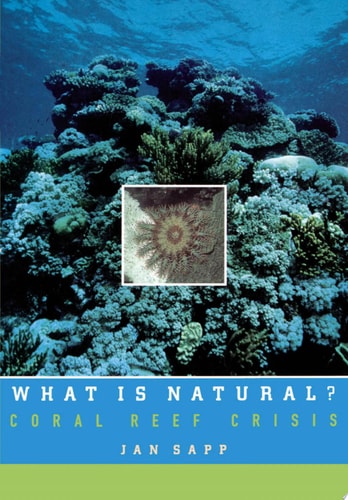
What Is Natural?: Coral Reef Crisis
0
0
As an Amazon Associate and affiliate partner, Menrva Books earns from qualifying purchases. Learn more
Author Description
During the late 1960s and 1970s, massive herds of poisonous crown-of-thorns starfish suddenly began to infest coral reef communities around the world, leaving in their wake devastation comparable to a burnt-out rainforest. In What is Natural?, Jan Sapp both examines this ecological catastrophe and captures the intense debate among scientists about what caused the crisis, and how it should be handled. The crown-of-thorns story takes readers on tropical expeditions around the world, and into both marine laboratories and government committees, where scientists rigorously search for answers to the many profound questions surrounding this event. Were these fierce starfish outbreaks the kind of manmade disaster heralded by such environmentalists as Rachel Carson in Silent Spring? Indeed, discussions of the cause of the starfish plagues have involved virtually every environmental issue of our timeover-fishing, pesticide use, atomic testing, rain forest depletion, and over-population, but many marine biologists maintain that the epidemic is a natural feature of coral-reef life, an ecological "balance of nature" that should not to be tampered with until we know the scientific truth of the crisis. But should we search for the scientific truth before taking action? And what if an environmental emergency cannot wait for a rigorous scientific search for "the truth?" The starfish plagues are arguably one of most mysterious ecological phenomena of this century. Through the window of this singular event, What is Natural lucidly illustrates the complexity of environmental issues while probing the most fundamental questions about the relationship between man and nature.
Menrva's Summary
THE THESIS
This book investigates whether the massive crown-of-thorns starfish outbreaks of the 1960s and 1970s represent a man-made ecological disaster or a natural, cyclical phenomenon. Jan Sapp, a historian of science, utilizes archival research and interviews with marine biologists to examine the intense scientific and political debates surrounding the crisis. He presents a framework that contrasts the precautionary principle against the need for empirical evidence in environmental management.
THE SCOPE MAP
What You Will Find
- Historical analysis of the crown-of-thorns starfish infestations during the late 1960s and 1970s.
- Examination of the intersection between marine biology, government policy, and environmental activism.
- Case studies of scientific expeditions and laboratory research conducted during the period.
Scope Limits
- The text does not provide a definitive resolution to the cause of the starfish plagues.
- It does not offer a comprehensive guide to modern coral reef conservation techniques.
THE AUTHORITY PERSPECTIVE
Experts and readers frequently note the book's balanced approach to complex environmental debates and its clear documentation of scientific disagreement. It is often cited as a valuable case study for understanding how environmental crises are framed and debated within the scientific community.
Page Count:
287
Publication Date:
1999-01-01
Publisher:
Oxford University Press
ISBN-10:
019028417X
ISBN-13:
9780190284176
Science
Nature
Philosophy
Categories
Starfishes
Marine Biology
Environment
Conservation
Kindle Store
Philosophy history
NATURE Ecology
Nature
Oceans & Seas
Kindle eBooks
Coral Reefs And Islands
Ecology
Environmental History
Community Tags
Similar Books