A Catholic Modernity?: Charles Taylor's Marianist Award Lecture
0
0
As an Amazon Associate and affiliate partner, Menrva Books earns from qualifying purchases. Learn more
Author Description
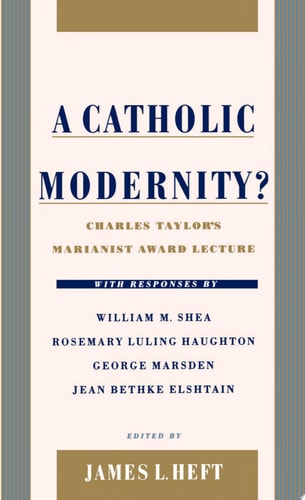
This book offers a series of reflections on the state of Christianity, and especially Catholicism, in the world today. The centerpiece of the volume is a lecture by the renowned philosopher Charles Taylor, from which the title of the book is taken. The lecture, delivered at Dayton University in January of 1996, offered Taylor the opportunity to speak about the religious dimensions of his intellectual commitment--dimensions left implicity in his philosophical writing. In fact, this is the only place where Taylor, a Roman Catholic, spells out his theological views and his sense of the cultural placement of Catholicism, its history and trajectory. He uses the occasion to argue against the common claim that obstacles to religious belief in modern culture are epistemic--that they have to do with the triumph of the scientific worldview. The real obstacles, says Taylor, are moral and spiritual, having to do with the historic failures of religious institutions.Four well-known commentators on religion and society, two Protestant, two Catholic, were invited to respond to Taylor's lecture: William M. Shea, George Marsden, Jean Bethke Elshtain, and Rosemary Luling-Haughton. Their chapters offer a variety of astute reflections on the tensions between religion and modernity, and in particular on the role that Catholicism can and should play in contemporary society. The volume concludes with Taylor's perceptive and thoughtful response to his interlocutors. A Catholic Modernity provides one of the most thoughtful conversations to date about the place of the Catholic Church in the modern world, and more generally, about the role of religion in democratic liberal societies.
Menrva's Summary
THE THESIS
This volume investigates the compatibility of Roman Catholic belief with the structures and values of modern secular society. Edited by James L. Heft, the text centers on a lecture by philosopher Charles Taylor, who argues that the primary barriers to religious faith in the contemporary era are not scientific or epistemic, but rather moral and spiritual in nature. The book compiles Taylor's rare explicit theological reflections alongside critical responses from four prominent scholars, creating a multi-disciplinary dialogue on the institutional history and future trajectory of the Church.
THE SCOPE MAP
What You Will Find
- A primary lecture text by Charles Taylor detailing his personal theological framework.
- Four distinct academic responses from William M. Shea, Rosemary Luling Haughton, George Marsden, and Jean Bethke Elshtain.
- A concluding synthesis where Taylor addresses the critiques and observations of his interlocutors.
- Analysis of the intersection between democratic liberalism and religious institutional identity.
Scope Limits
- The text does not provide a comprehensive history of Catholic doctrine.
- It does not offer a systematic guide to modern theology, focusing instead on the specific lecture and its immediate critical reception.
THE AUTHORITY PERSPECTIVE
Scholars and theologians frequently cite this work as a critical entry point for understanding Charles Taylor's personal religious commitments. Experts highlight the text as a valuable resource for those examining the tension between traditional faith and the secularized public sphere.
Page Count:
125
Publication Date:
1999-01-01
Publisher:
Oxford University Press
ISBN-10:
0190285028
ISBN-13:
9780190285029
Religion
Philosophy
Theology
Sociology of Religion
Modernity
Catholicism
Community Tags
Similar Books