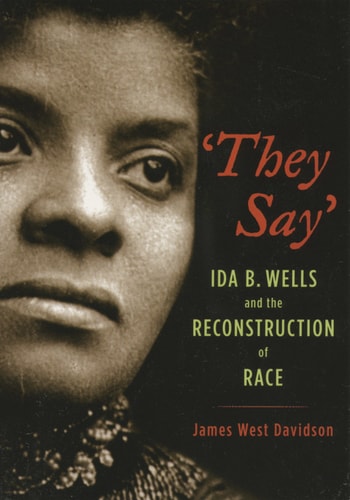
"They Say": Ida B. Wells and the Reconstruction of Race
0
0
As an Amazon Associate and affiliate partner, Menrva Books earns from qualifying purchases. Learn more
Author Description
Between 1880 and 1930, Southern mobs hanged, burned, and otherwise tortured to death at least 3,300 African Americans. And yet the rest of the nation largely ignored the horror of lynching or took it for granted, until a young schoolteacher from Tennessee raised her voice. Her name was Ida B. Wells. In "They Say," historian James West Davidson recounts the first thirty years of this passionate woman's life--as well as the story of the great struggle over the meaning of race in post-emancipation America. Davidson captures the breathtaking, often chaotic changes that swept the South as Wells grew up in Holly Springs, Mississippi: the spread of education among the free blacks, the rise of political activism, the bitter struggles for equality in the face of entrenched social custom. As Wells came of age she moved to bustling Memphis, eager to worship at the city's many churches (black and white), to take elocution lessons and perform Shakespeare at evening soirées, to court and spark with the young men taken by her beauty. But Wells' quest for fulfillment was thwarted as whites increasingly used race as a barrier separating African Americans from mainstream America. Davidson traces the crosscurrents of these cultural conflicts through Ida Wells' forceful personality. When a conductor threw her off a train for not retreating to the segregated car, she sued the railroad--and won. When she protested conditions in the segregated Memphis schools, she was fired--and took up full-time journalism. And in 1892, when an explosive lynching rocked Memphis, she embarked full-blown on the career for which she is now remembered, as an outspoken writer and lecturer against lynching. Richly researched and deftly written, "They Say" offers a gripping portrait of the young Ida B. Wells, shedding light not only on how one black American defined her own aspirations and her people's freedom, but also on the changing meaning of race in America.
Menrva's Summary
THE THESIS
How did the early life and activism of Ida B. Wells reflect the broader, volatile transformation of race relations in the post-emancipation American South? Historian James West Davidson utilizes primary source documents, including Wells' own writings and contemporary journalistic accounts, to reconstruct the social and political environment of the late 19th century. The author argues that Wells' personal trajectory from a schoolteacher to a prominent anti-lynching crusader serves as a microcosm for the systemic struggle for equality during the Reconstruction and post-Reconstruction eras. By situating her experiences within the shifting landscape of Southern law and custom, Davidson provides a framework for understanding the hardening of racial barriers in the United States.
THE SCOPE MAP
What You Will Find
- Analysis of the socio-political climate in Holly Springs, Mississippi, and Memphis, Tennessee, between 1860 and 1892.
- Examination of the rise of segregationist policies and the normalization of lynching as a tool of social control.
- Documentation of Wells' early legal battles against railroad segregation and her transition into investigative journalism.
Scope Limits
- The narrative focuses primarily on the first thirty years of Wells' life and does not provide a comprehensive biography of her later years or her full career in the 20th century.
THE AUTHORITY PERSPECTIVE
Scholars and historians note the text's meticulous use of archival research to contextualize Wells' individual agency against the backdrop of systemic racial violence. Readers frequently highlight the book's ability to balance personal narrative with rigorous historical analysis, making it a valuable resource for understanding the origins of the modern civil rights movement.
Page Count:
256
Publication Date:
2008-01-01
Publisher:
Oxford University Press
ISBN-10:
0190289554
ISBN-13:
9780190289553
History
Politics
Biography
Biography Autobiography
African Americans
Social History
Ethnic Studies
Historical
Race Relations
Community & Culture
American History
Educational Resources
Categories
Woman Studies
Americas
Women in History
Civil Rights
Racism
United States
English & College Success
African American
Kindle Store
English
Kindle eBooks
Social reformers
Special Topics
Community Tags
Similar Books