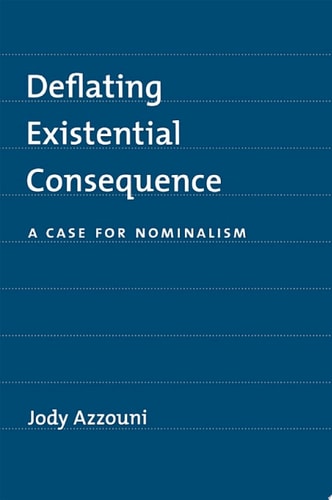
Deflating Existential Consequence: A Case for Nominalism
0
0
As an Amazon Associate and affiliate partner, Menrva Books earns from qualifying purchases. Learn more
Author Description
If we must take mathematical statements to be true, must we also believe in the existence of abstracta eternal invisible mathematical objects accessible only by the power of pure thought? Jody Azzouni says no, and he claims that the way to escape such commitments is to accept (as an essential part of scientific doctrine) true statements which are about objects that don't exist in any sense at all. Azzouni illustrates what the metaphysical landscape looks like once we avoid a militant Realism which forces our commitment to anything that our theories quantify. Escaping metaphysical straitjackets (such as the correspondence theory of truth), while retaining the insight that some truths are about objects that do exist, Azzouni says that we can sort scientifically-given objects into two categories: ones which exist, and to which we forge instrumental access in order to learn their properties, and ones which do not, that is, which are made up in exactly the same sense that fictional objects are. He offers as a case study a small portion of Newtonian physics, and one result of his classification of its ontological commitments, is that it does not commit us to absolute space and time.
Menrva's Summary
THE THESIS
The book investigates whether the acceptance of scientific truths necessitates a commitment to the existence of abstract mathematical objects. Jody Azzouni, a professor of philosophy, challenges the traditional realist assumption that quantifying over objects in scientific theories requires their ontological existence. He proposes a framework where scientific statements can be true without implying the existence of the objects they describe, effectively separating truth from ontological commitment.
THE SCOPE MAP
What You Will Find
- A defense of nominalism within the context of scientific realism.
- A distinction between objects that exist through instrumental access and those that are constructed.
- A case study applying this ontological classification to Newtonian physics.
Scope Limits
- The text does not provide a comprehensive history of nominalist thought.
- It does not address every branch of theoretical physics beyond the selected Newtonian case study.
THE AUTHORITY PERSPECTIVE
Experts in the philosophy of mathematics and science recognize this work as a significant contribution to the debate on ontological commitment. Readers frequently note the technical density of the prose, which requires a strong background in analytic philosophy to fully grasp the author's arguments.
Page Count:
241
Publication Date:
2004-01-01
Publisher:
Oxford University Press
ISBN-10:
0190289457
ISBN-13:
9780190289454
Philosophy
Metaphysics
Nominalism
Ontology
Mathematics
Philosophy of
Logic & Critical Reasoning
Community Tags
Similar Books