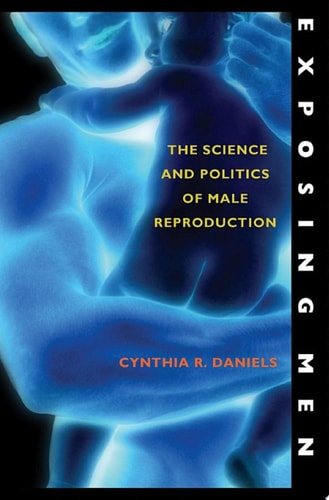
Exposing Men: The Science and Politics of Male Reproduction
0
0
As an Amazon Associate and affiliate partner, Menrva Books earns from qualifying purchases. Learn more
Author Description
Exposing Men examines how ideals of masculinity have long skewed our societal--and scientific--understanding of one of the pillars of male identity: reproductive health. Only with the recent public exposure of men's reproductive troubles has the health of the male body been thrown into question, and along with it deeper masculine ideals. Whereas once men's sexual and reproductive abilities were the most taboo of topics, today erectile dysfunction is a multi-billion dollar business, and magazine articles trumpet male reproductive decline with headlines such as "You're Half the Man Your Father Was." Cynthia R. Daniels casts a gimlet eye on our world of plummeting sperm counts, spiking reproductive cancers, sperm banks, and pharmacological cures for impotence in order to assess the true state of male health. What she finds is male reproductive systems damaged by toxins and war, and proof piling up that men through sperm, pass on harm to the children they father. Yet, despite the evidence that men's health, as much as women's, significantly affects the vitality of their offspring, Daniels also sees a society holding on to outdated assumptions, one in which men ignore blatant health risks as they struggle to live up to antiquated ideas of manliness.
Menrva's Summary
THE THESIS
This book investigates how cultural ideals of masculinity have historically distorted scientific and societal understandings of male reproductive health. Cynthia R. Daniels, a scholar in gender and public policy, utilizes a synthesis of medical data, historical analysis, and sociological observation to argue that societal expectations of manliness frequently cause men to ignore significant environmental and biological health risks. She posits that the focus on male reproductive decline reveals a systemic failure to address the impact of toxins and external stressors on the male body and subsequent generations.
THE SCOPE MAP
What You Will Find
- Analysis of the intersection between environmental toxins and male reproductive health
- Examination of the cultural history of masculinity and its influence on medical research
- Discussion of the implications of male reproductive health on offspring vitality
- Critique of the pharmaceutical industry's approach to male sexual dysfunction
Scope Limits
- The text does not provide a clinical medical guide for individual reproductive treatment
- It does not focus on female reproductive health beyond its comparative role in societal health narratives
THE AUTHORITY PERSPECTIVE
Scholars and critics recognize this work as a significant contribution to the sociology of gender and health, noting its ability to bridge the gap between biological data and cultural critique. Readers frequently observe that the text provides a dense, well-researched examination of how social pressures shape medical outcomes.
Page Count:
262
Publication Date:
2006-01-01
Publisher:
Oxford University Press
ISBN-10:
0190287462
ISBN-13:
9780190287467
Gender Studies
Reproductive health
Sociology
Sex Role
Mens Studies
Science and Society
Public Policy
Public Health
Men
Community Tags
Similar Books