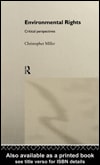
Environmental Rights
0
0
As an Amazon Associate and affiliate partner, Menrva Books earns from qualifying purchases. Learn more
Author Description
Environmental Rights offers new perspectives on contemporary debates over rights and environmental issues, criticising the traditional ecocentric formulation and the view that it is meaningful to speak of environmental rights as a sub-set of human rights, infringed when individuals experience an environmental quality falling below a recognized standard.Drawing on key theories of contemporary philosophers and jurists, as well as case reports from judicial decisions in English, European and US courts, the book examines recent developments within environmental law and policy in the UK and the European Union. Specific rights of the individual are examined - the right to clean air and water, access to information, the right to participate in environmental decisions - as well as practical obstacles to the exercising of such rights, including problems of scientific evidence, high cost of litigation, legal recognition of environmental pressure groups.Beginning with an examination of the notion of rights to the environment and to the identification of such rights, the book moves on to describe the arena (town and country planning) in which many of the subsequent debates over rights have originated. The rights discourse is then developed in the context of specific elements of the environment: the atmosphere, water, ionising radiation, land wildlife, before the final chapter discusses the legal protection currently enjoyed by certain animal species, and examines the idea of ecocentric rights.Christopher Miller concludes that the environment does not lend itself to a rights discourse but rather one which stresses the important duties which individuals must assume if environmental threats to human welfare are to be averted.
Menrva's Summary
THE THESIS
This book investigates whether the concept of environmental rights is a coherent legal framework or if it fails to address the complexities of environmental protection. Christopher J. Miller, an expert in legal theory and environmental policy, challenges the traditional ecocentric approach and the classification of environmental rights as a subset of human rights. By synthesizing philosophical discourse with practical judicial outcomes, the author argues that a focus on individual duties is more effective than a rights-based discourse for mitigating environmental threats.
THE SCOPE MAP
What You Will Find
- Comparative analysis of judicial decisions from English, European, and US courts.
- Examination of specific rights including access to information, participation in decision-making, and rights to clean air and water.
- Discussion of practical litigation barriers such as scientific evidence requirements and the high costs of legal action.
- Theoretical critique of ecocentric rights versus human-centric duty-based frameworks.
THE AUTHORITY PERSPECTIVE
Legal scholars and practitioners recognize this text as a critical contribution to the debate surrounding the limitations of rights-based environmental law. Readers frequently note the academic density of the prose and the author's rigorous application of case law to theoretical arguments.
Page Count:
0
Publication Date:
2003-01-01
Publisher:
Taylor & Francis Inc
ISBN-10:
020320543X
ISBN-13:
9780203205433
Philosophy
Politics
Law
Nonfiction
Human rights
Community Tags
Similar Books