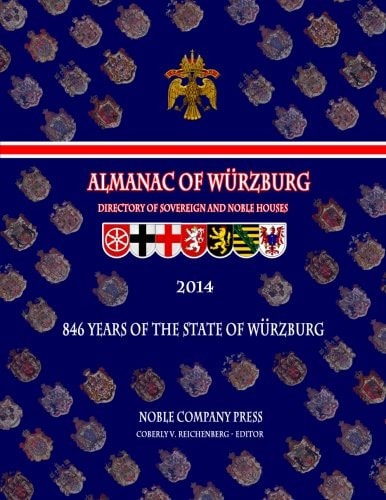
Almanac of Wurzburg 2014
0
0
As an Amazon Associate and affiliate partner, Menrva Books earns from qualifying purchases. Learn more
Author Description
Directory of International Sovereign and Noble Houses: Various monarchies, sovereign houses, and states have long maintained records of members of royal and noble houses. The Almanach de Gotha served as a form of privately-published social register across national boundaries for European royalty and nobility from the late 18th century until its records were destroyed by the Soviets in 1944.Diligent researchers located medieval data at the Würzburg Archives in the Würzburger Residenz, Germany. Data found there helped form the basis of the reconstructed Almanac of Würzburg, making it a useful historical directory of ancient and modern royalty and nobility. The Almanac includes reigning and non-reigning sovereign houses, higher nobility, and nobles of many nations.While some revisionists of history purport today that original Almanacs, such as the Almanach de Gotha, were legal documents, they in fact were not. They were simply an early version of a "Who's Who" among royalty and nobility and served mainly as a social register. The fact that a name or title is not listed often speaks volumes about the petty nature of editors and backers of a private publication in a vain assumption that readers will find those whom are excluded as somehow less credible. It is a routine tactic that continues today on the internet, the current version of the Wild West.For more information, see http://www.noblecompany.org/almanac/
Menrva's Summary
THE THESIS
This work reconstructs historical directories of European royalty and nobility using archival data from the Würzburg Archives. The Almanac of Würzburg 2014 aims to provide a comprehensive historical directory of ancient and modern royalty and nobility, including reigning and non-reigning sovereign houses, higher nobility, and nobles from various nations. It draws upon medieval data discovered at the Würzburger Residenz in Germany, serving as a successor to the historical Almanach de Gotha. The text clarifies that such almanacs were primarily social registers rather than legal documents, reflecting the social standing and editorial practices of their time.
THE SCOPE MAP
- Reconstruction of historical directories of sovereign and noble houses.
- Inclusion of reigning and non-reigning sovereign houses.
- Coverage of higher nobility and nobles from multiple nations.
- Utilizes medieval data sourced from the Würzburg Archives.
- Provides context on the historical function of such almanacs as social registers.
- Discusses the editorial practices and social implications of inclusion/exclusion in historical directories.
THE AUTHORITY PERSPECTIVE
The Almanac of Würzburg 2014 is presented as a historical directory, drawing upon archival research to reconstruct records of European royalty and nobility. Its purpose is to serve as a reference for ancient and modern noble houses, expanding upon the legacy of publications like the Almanach de Gotha. The work emphasizes its foundation in primary source data from the Würzburg Archives, distinguishing it as a research-driven compilation. The text also offers commentary on the nature of historical social registers and their editorial biases.
Page Count:
616
Publication Date:
2014-06-15
Publisher:
Noble Company Press
ISBN-10:
0692227229
ISBN-13:
9780692227220
History
Non-Fiction
Royalty
Nobility
Directories
Genealogy
Community Tags
Similar Books