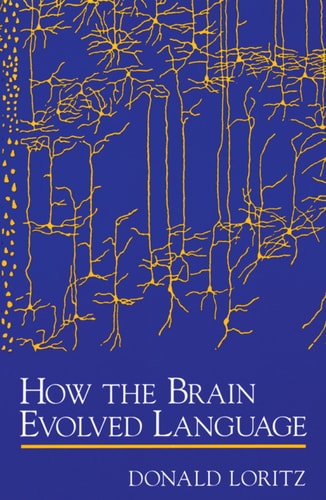
How the Brain Evolved Language
0
0
As an Amazon Associate and affiliate partner, Menrva Books earns from qualifying purchases. Learn more
Author Description
How can an infinite number of sentences be generated from one human mind? How did language evolve in apes? In this book Donald Loritz addresses these and other fundamental and vexing questions about language, cognition, and the human brain. He starts by tracing how evolution and natural adaptation selected certain features of the brain to perform communication functions, then shows how those features developed into designs for human language. The result -- what Loritz calls an adaptive grammar -- gives a unified explanation of language in the brain and contradicts directly (and controversially) the theory of innateness proposed by, among others, Chomsky and Pinker.
Menrva's Summary
THE THESIS
This book investigates the biological and evolutionary mechanisms that enable the human brain to generate an infinite number of sentences. Donald Loritz, a scholar in the field of linguistics, utilizes principles of evolutionary biology and natural adaptation to propose a model of language development. He argues that specific brain functions were selected over time to facilitate communication, ultimately forming what he defines as an adaptive grammar. This framework serves as a direct challenge to the prevailing innateness theories championed by figures such as Noam Chomsky and Steven Pinker.
THE SCOPE MAP
What You Will Find
- Evolutionary origins of communication functions in the brain
- The concept of adaptive grammar as a linguistic model
- Comparative analysis of language development in primates and humans
- Critique of nativist linguistic theories
Scope Limits
- The text does not provide a comprehensive history of all human languages
- It does not focus on sociolinguistic or cultural aspects of language usage
THE AUTHORITY PERSPECTIVE
Experts and readers often note that the book presents a provocative alternative to mainstream generative linguistics. The text is recognized for its technical focus on the intersection of cognitive science and evolutionary theory, making it a significant contribution to debates regarding the origins of human language.
Page Count:
237
Publication Date:
2002-01-01
Publisher:
Oxford University Press
ISBN-10:
0190287985
ISBN-13:
9780190287986
Science
Philosophy
English & College Success
Neuroscience
English
Biolinguistics
Linguistics
Evolutionary Biology
Community Tags
Other Editions(3)
Similar Books