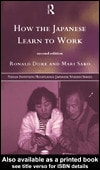
How the Japanese Learn to Work
0
0
As an Amazon Associate and affiliate partner, Menrva Books earns from qualifying purchases. Learn more
Author Description
As many countries in the world seek to improve their economic performance by increasing their vocational education and training, Japan is being looked to as a leader in this field - the ideal model to imitate. This book provides a thorough examination of vocational education and training in all parts of the Japanese education system; from primary education to in-house training within companies and on the shop floor. This study highlights the role of the government, and shows how success in Japan is often achieved by going against what is regarded as ideal practice elsewhere: for example, much Japanese training is carried out informally by colleagues, the motivation being pride in doing the job well rather than a means to personal advancement.
Menrva's Summary
THE THESIS
This book investigates the structural mechanisms of Japanese vocational education and training to determine how they contribute to the nation's economic performance. Ronald Philip Dore, a prominent sociologist and expert on Japanese society, utilizes a comparative framework to analyze how Japan's educational system integrates with corporate training. He argues that Japan's success often stems from practices that diverge from Western models, emphasizing informal peer-to-peer learning and a collective work ethic over individualistic advancement.
THE SCOPE MAP
What You Will Find
- Comprehensive analysis of vocational training from primary schooling to corporate shop-floor instruction.
- Examination of the government's role in shaping educational policy and workforce development.
- Case studies comparing Japanese training methodologies with international standards.
- Analysis of the cultural motivations behind skill acquisition, such as professional pride and group cohesion.
THE AUTHORITY PERSPECTIVE
Experts recognize this work as a foundational text for understanding the intersection of Japanese culture and industrial training. Readers frequently note the academic density of the prose, which provides a rigorous look at institutional structures rather than a simple how-to manual.
Page Count:
158
Publication Date:
2004-01-01
Publisher:
Taylor & Francis Inc
ISBN-10:
0203210220
ISBN-13:
9780203210222
Economics
Business
Non-Fiction
Sociology
Education
Japan
Vocational Training
Community Tags
Similar Books