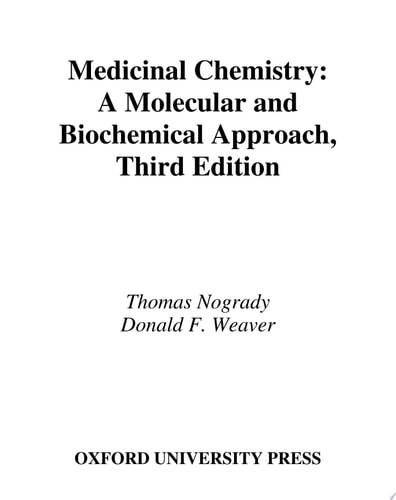
Medicinal Chemistry: A Molecular and Biochemical Approach
0
0
As an Amazon Associate and affiliate partner, Menrva Books earns from qualifying purchases. Learn more
Author Description
Fully updated and rewritten by a basic scientist who is also a practicing physician, the third edition of this popular textbook remains comprehensive, authoritative and readable. Taking a receptor-based, target-centered approach, it presents the concepts central to the study of drug action in a logical, mechanistic way grounded on molecular and principles. Students of pharmacy, chemistry and pharmacology, as well as researchers interested in a better understanding of drug design, will find this book an invaluable resource. Starting with an overview of basic principles, Medicinal Chemistry examines the properties of drug molecules, the characteristics of drug receptors, and the nature of drug-receptor interactions. Then it systematically examines the various families of receptors involved in human disease and drug design. The first three classes of receptors are related to endogenous molecules: neurotransmitters, hormones and immunomodulators. Next, receptors associated with cellular organelles (mitochondria, cell nucleus), endogenous macromolecules (membrane proteins, cytoplasmic enzymes) and pathogens (viruses, bacteria) are examined. Through this evaluation of receptors, all the main types of human disease and all major categories of drugs are considered. There have been many changes in the third edition, including a new chapter on the immune system. Because of their increasingly prominent role in drug discovery, molecular modeling techniques, high throughput screening, neuropharmacology and genetics/genomics are given much more attention. The chapter on hormonal therapies has been thoroughly updated and re-organized. Emerging enzyme targets in drug design (e.g. kinases, caspases) are discussed, and recent information on voltage-gated and ligand-gated ion channels has been incorporated. The sections on antihypertensive, antiviral, antibacterial, anti-inflammatory, antiarrhythmic, and anticancer drugs, as well as treatments for hyperlipidemia and peptic ulcer, have
Menrva's Summary
THE THESIS
This text investigates the fundamental molecular and biochemical mechanisms that govern drug action and design within the human body. The authors, a basic scientist and a practicing physician, utilize a receptor-based, target-centered framework to bridge the gap between theoretical chemistry and clinical application. By grounding the study of pharmacology in molecular principles, the book provides a systematic approach to understanding how drugs interact with biological systems to treat human disease.
THE SCOPE MAP
What You Will Find
- Comprehensive analysis of drug-receptor interactions and molecular properties.
- Detailed examination of receptor families, including neurotransmitters, hormones, and immunomodulators.
- Coverage of modern drug discovery techniques such as high-throughput screening, molecular modeling, and genomics.
Scope Limits
- The text focuses primarily on the biochemical and molecular mechanisms of drug action rather than clinical patient management or bedside nursing protocols.
THE AUTHORITY PERSPECTIVE
Experts and educators recognize this work as a foundational textbook for pharmacy and chemistry students due to its logical, mechanistic structure. Readers frequently note the academic density of the prose, which effectively synthesizes complex pharmacological concepts for advanced learners and researchers.
Page Count:
663
Publication Date:
2005-01-01
Publisher:
Oxford University Press
ISBN-10:
0190282967
ISBN-13:
9780190282967
Science
Chemistry
Pharmacology
Toxicology
textbook
Allied Health
Biochemistry
Medical
Medicine
Earth Sciences
Community Tags
Similar Books