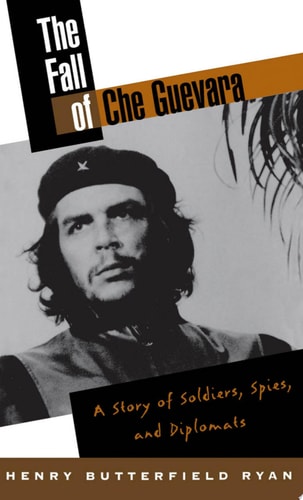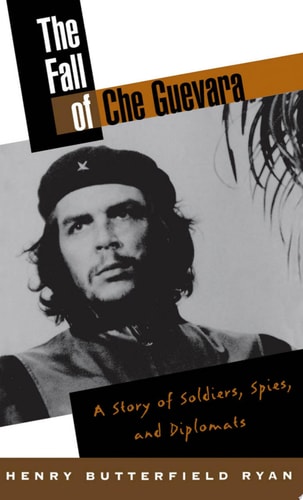
The Fall of Che Guevara: A Story of Soldiers, Spies, and Diplomats
0
0
As an Amazon Associate and affiliate partner, Menrva Books earns from qualifying purchases. Learn more
Author Description
The Fall of Che Guevara tells the story of Guevara's last campaign, in the backwoods of Bolivia, where he hoped to ignite a revolution that would spread throughout South America. For the first time, this book shows in detail the strategy of the U.S. and Bolivian governments to foil his efforts. Based on numerous interviews and on secret documents obtained through the Freedom of Information Act from the CIA, the State Department, the Pentagon, and the National Security Archive, this work casts new light on the roles of a Green Beret detachment sent to train the Bolivians and of the CIA and other U.S. agencies in bringing Guevara down. Ryan's shows that Guevara was an agent of Cuban foreign policy from the time he met Fidel Castro in 1955 until his death--not a mere independent revolutionary, as many scholars have claimed. Guevara's attempted insurgency in Bolivia was in reality a Cuban attempt to achieve another badly-needed revolutionary success.This dramatic account of the last days of Che Guevara will appeal to scholars and students of United States foreign policy and Latin American history, and to all those interested in this revolutionary's remarkable life.
Menrva's Summary
THE THESIS
This work investigates the strategic failure of Che Guevara’s final insurgency in Bolivia and the specific roles played by U.S. and Bolivian government entities in his capture. Henry Butterfield Ryan, a scholar of U.S. foreign policy, utilizes declassified documents obtained through the Freedom of Information Act to reconstruct the events of 1967. By synthesizing records from the CIA, the State Department, and the Pentagon, the author argues that Guevara functioned primarily as an instrument of Cuban foreign policy rather than as an autonomous revolutionary actor. The text provides a detailed examination of the logistical and political maneuvers employed by the U.S. military and intelligence agencies to neutralize the threat of a continental uprising.
THE SCOPE MAP
What You Will Find
- Analysis of the 1967 Bolivian campaign and the subsequent counter-insurgency operations.
- Documentation regarding the deployment and training activities of U.S. Green Beret detachments.
- Evidence regarding the coordination between the CIA and the Bolivian government.
- Re-evaluation of Guevara’s relationship with Fidel Castro and Cuban state objectives.
Scope Limits
- The text does not provide a comprehensive biography of Guevara’s early life or his time in the Cuban government.
- The analysis is primarily focused on the geopolitical and military aspects of the Bolivian campaign rather than the internal social dynamics of the local population.
THE AUTHORITY PERSPECTIVE
Experts and historians frequently cite this work as a critical resource for understanding the intersection of U.S. foreign policy and Latin American revolutionary movements during the Cold War. Readers note the academic rigor of the research, particularly the effective use of previously classified government documents to clarify the extent of U.S. involvement in the region.
Page Count:
240
Publication Date:
1998-01-01
Publisher:
Oxford University Press
ISBN-10:
019028367X
ISBN-13:
9780190283674
Biography
History
Military History
Bolivia
Guerrillas
American History
Cold War
Insurgency