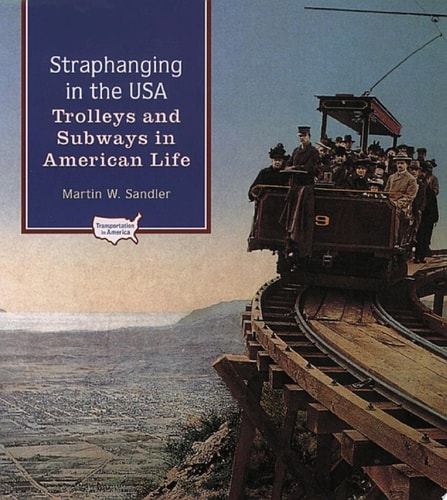
Straphanging in the USA: Trolleys and Subways in American Life
0
0
As an Amazon Associate and affiliate partner, Menrva Books earns from qualifying purchases. Learn more
Author Description
A riveting look at the evolution of transportation in American cities, Straphanging in America begins with an examination of the horsecar and omnibus, then traces the extraordinary impact of the cable car, elevated railway, interurban, and subway on city life -- and the nation. Capturing people's imaginations with its "magical" use of electricity, trolley cars made pollution-free, inexpensive, mass urban transportation possible and created suburbs. Interurbans connected cities, spawned new towns, and made overland travel a national pastime. Subways solved the problem of street congestion. Beyond the effects on landscape, urban transport unified cities as people of all economic backgrounds rubbed elbows. Vividly illustrating America's urban transformation, Straphanging in America captures the excitement of a nation and its burgeoning technology.
Menrva's Summary
THE THESIS
This book investigates how the development and implementation of various urban transit technologies fundamentally reshaped the physical landscape and social fabric of American cities. Martin W. Sandler, an experienced historian and author, utilizes a chronological framework to analyze the transition from horse-drawn vehicles to electrified rail systems. He argues that these advancements were not merely engineering feats but catalysts for suburban expansion, social integration, and the modernization of urban life.
THE SCOPE MAP
What You Will Find
- Historical analysis of horsecars, omnibuses, cable cars, elevated railways, and subways.
- Examination of the role of electricity in urban development.
- Discussion of the socio-economic impact of mass transit on city demographics.
Scope Limits
- The text focuses primarily on the development of rail-based transit and does not cover the later dominance of the automobile or modern bus systems.
THE AUTHORITY PERSPECTIVE
Readers frequently note the accessible, narrative-driven prose that makes complex historical shifts easy to follow. Experts highlight this as a useful introductory text for understanding the foundational role of public transit in the growth of the American metropolis.
Page Count:
63
Publication Date:
2003-01-01
Publisher:
Oxford University Press
ISBN-10:
0190285206
ISBN-13:
9780190285203
History
American History
Subways
English & College Success
Urban Studies
Transportation
Technology
English
Community Tags
Similar Books