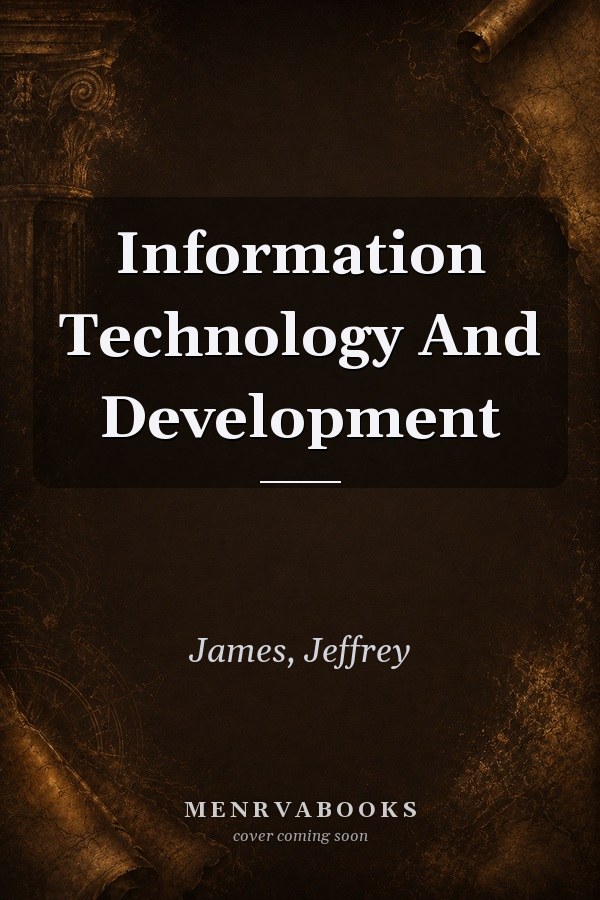
Information Technology and Development
0
0
As an Amazon Associate and affiliate partner, Menrva Books earns from qualifying purchases. Learn more
Author Description
Attempts To Bring The Benefits Of Information Technology In The Form Of The Internet To Developing Countries Have, To Date, Foundered On The Belief That This Requires The Beneficiaries To Access The Technology Directly. As A Result, The Perceived Huge Benefits Of Such An Enterprise Have Often Failed To Materialise. This Original Contribution To The Debate On Developing Countries And It Suggests That The Benefits Of The Internet Can Be Passed On Via An Intermediary. That Is, What Matters Is Not The Internet Itself, Rather Its Ability To Provide Information That Can Be Made Relevant And Useful Locally. Intermediaries Are Arguably More Likely To Provide Such Information And Hence More Likely To Promote What Amartya Sen Called Individual 'functionings', For Example The Ability To Be Free Of Illness. Jeffrey James Is An Impressive Servant To The Discipline Of Development Studies, Here He Brings Together Previously Fragmented Literatures To Break New Ground In Internet Intermediation. Information Technology And Development Will Interest Development Economists And Practitioners In Equal Amounts.
Menrva's Summary
THE THESIS
This book investigates whether the direct provision of internet access to developing nations is an ineffective strategy for fostering economic and social development. Jeffrey James, a scholar in development studies, argues that the focus should shift from universal direct access to the use of intermediaries who can translate digital information into locally relevant and actionable knowledge. By synthesizing fragmented literature, the author proposes a framework that prioritizes the practical application of information to enhance individual 'functionings' as defined by Amartya Sen.
THE SCOPE MAP
What You Will Find
- Analysis of the failure of direct internet access initiatives in developing regions.
- A theoretical framework for the role of intermediaries in information dissemination.
- Evaluation of how digital information translates into local health and economic improvements.
- Synthesis of development economics literature regarding technological adoption.
THE AUTHORITY PERSPECTIVE
Experts in development economics recognize this work as a significant contribution to the discourse on digital inequality and technological implementation. Readers frequently note the clarity with which the author bridges the gap between abstract economic theory and practical development policy.
Page Count:
144
Publication Date:
2004-01-01
Publisher:
Routledge
ISBN-10:
0203325508
ISBN-13:
9780203325506
Business
History
Economics
Technology
Information Technology
International Development
Community Tags
Similar Books