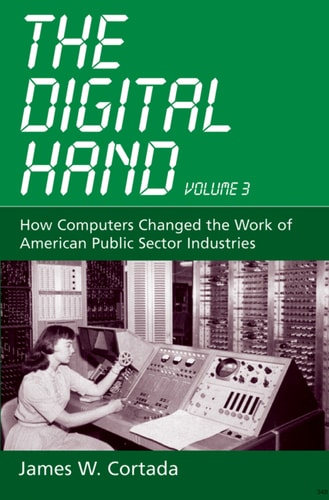
The Digital Hand, Vol 3: How Computers Changed the Work of American Public Sector Industries
0
0
As an Amazon Associate and affiliate partner, Menrva Books earns from qualifying purchases. Learn more
Author Description
In The third volume of The Digital Hand, James W. Cortada completes his sweeping survey of the effect of computers on American industry, turning finally to the public sector, and examining how computers have fundamentally changed the nature of work in government and education. This book goes far beyond generalizations about the Information Age to the specifics of how industries have functioned, now function, and will function in the years to come. Cortada combines detailed analysis with narrative history to provide a broad overview of computings and telecommunications role in the entire public sector, including federal, state, and local governments, and in K-12 and higher education. Beginning in 1950, when commercial applications of digital technology began to appear, Cortada examines the unique ways different public sector industries adopted new technologies, showcasing the manner in which their innovative applications influenced other industries, as well as the U.S. economy as a whole. He builds on the surveys presented in the first volume of the series, which examined sixteen manufacturing, process, transportation, wholesale and retail industries, and the second volume, which examined over a dozen financial, telecommunications, media, and entertainment industries. With this third volume, The Digital Hand trilogy is complete, and forms the most comprehensive and rigorously researched history of computing in business since 1950, providing a detailed picture of what the infrastructure of the Information Age really looks like and how we got there. Managers, historians, economists, and those working in the public sector will appreciate Cortada's analysis of digital technology's many roles and future possibilities.
Menrva's Summary
THE THESIS
This volume investigates how the integration of digital computing and telecommunications fundamentally transformed the operational nature of American public sector industries, including government and education, from 1950 to the present. Dr. James W. Cortada, a historian of technology, utilizes extensive historical research and industry-specific analysis to document the adoption of digital tools. He argues that these technologies did not merely automate existing tasks but reshaped the structural foundations of public service delivery and institutional management. The work serves as the concluding installment of a comprehensive trilogy examining the broader impact of computing on the American economy.
THE SCOPE MAP
What You Will Find
- Historical analysis of computing adoption in federal, state, and local government agencies.
- Examination of digital transformation within K-12 and higher education systems.
- Comparative study of how public sector innovations influenced private industry practices.
- Longitudinal data tracking technological integration starting from 1950.
Scope Limits
- The text focuses primarily on the American public sector and does not provide a global comparative analysis.
- It does not offer technical manuals for specific software or hardware implementations.
THE AUTHORITY PERSPECTIVE
Experts and historians recognize this work as a definitive, rigorous account of the digital infrastructure within the American public sector. Readers frequently note the academic density of the prose, which makes it a primary resource for scholars and policy analysts interested in the history of information technology.
Page Count:
496
Publication Date:
2007-01-01
Publisher:
Oxford University Press
ISBN-10:
019029017X
ISBN-13:
9780190290177
History
Education
Information Management
Business History
computing
MIS
Public Policy
Professional Career & Trade
United States
Technology
Business
Community Tags
Similar Books