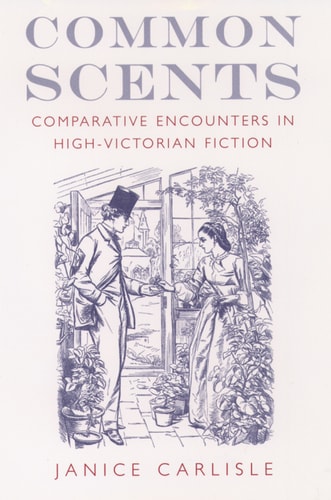
Common Scents: Comparative Encounters in High-Victorian Fiction
0
0
As an Amazon Associate and affiliate partner, Menrva Books earns from qualifying purchases. Learn more
Author Description
Who smells? Surveying nearly eighty novels written in the 1860s to answer that impolite question, Common Scents provides a new reading of Victorian values, particularly as they assess the relative merits of men and women, spirit and matter. In depictions of comparative encounters, the commonplace meetings of everyday life, such fiction often registers the inequalities that distinguish one individual from another by marking one of them with a smell. In a surprisingly consistent fashion, these references constitute what cultural anthropologists call an osmology, a system of differentiations that reveals the status within a particular culture of the persons and things associated with specific odors. Featuring often innocuous and even potentially pleasing aromas emanating from food, flowers, and certain kinds of labor, novels of the 1860s array their characters into distinct categories, finding in some rather than others olfactory proof of their materiality. Central to this osmology is the difference between characters who give off odors and those who do not, and this study draws upon the work of Victorian psychophysiologists and popular commentators on the senses to establish the subtlety with which fictional representations make that distinction. By exploring the far-reaching implications of this osmology in specific novels by Dickens, Eliot, Meredith, Oliphant, Trollope, and Yonge, Common Scents argues that the strikingly similar plots and characterizations typical of the 1860s, responding as they do to the economic and political concerns of the decade, reconfigure conventional understandings of the relations between men and women. Determining who smells reveals what Victorian culture at its epitome takes for granted as a deeply embedded common sense, the recognition of whose self-evident truth seems to be as instinctive and automatic as a response to an odor.
Menrva's Summary
THE THESIS
This study investigates how olfactory references in 1860s Victorian fiction function as a cultural system of differentiation, revealing societal hierarchies and gendered values. Janice Carlisle, a scholar of Victorian literature, utilizes a corpus of nearly eighty novels from the 1860s to analyze how authors employed descriptions of smell to categorize characters. By integrating the work of Victorian psychophysiologists and contemporary cultural theory, the book argues that these sensory markers reflect the era's economic and political anxieties regarding the status of men and women. The text posits that the ability to detect or possess an odor serves as a proxy for materiality and social standing within the Victorian worldview.
THE SCOPE MAP
What You Will Find
- A comprehensive survey of nearly eighty novels published during the 1860s.
- An analysis of the osmology, or the cultural system of odors, prevalent in Victorian literature.
- Examinations of works by prominent authors including Dickens, Eliot, Meredith, Oliphant, Trollope, and Yonge.
- Integration of historical psychophysiological theories and popular sensory commentary.
Scope Limits
- The analysis is strictly confined to the literary output of the 1860s.
- The study does not address olfactory representations in poetry, drama, or non-literary Victorian texts.
THE AUTHORITY PERSPECTIVE
Scholars recognize this work as a specialized contribution to the field of sensory history and Victorian literary criticism. Readers frequently note the academic density of the prose and the precision with which the author maps the intersection of sensory perception and social status.
Page Count:
231
Publication Date:
2004-01-01
Publisher:
Oxford University Press
ISBN-10:
0190290064
ISBN-13:
9780190290061
Gender Studies
Literary Criticism
English
English & College Success
Cultural History
Community Tags
Similar Books