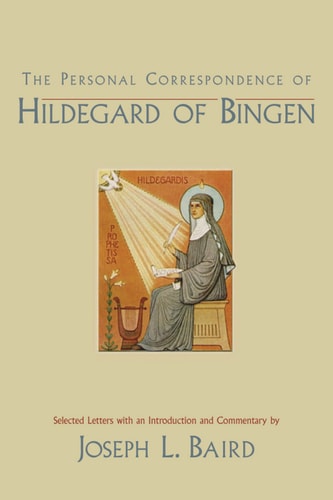
The Personal Correspondence of Hildegard of Bingen
0
0
As an Amazon Associate and affiliate partner, Menrva Books earns from qualifying purchases. Learn more
Author Description
Hildegard of Bingen (1098-1179) was one of the most remarkable women of her day. From early childhood she experienced religious visions, and at the age of eight she entered a cloistered religious life in the Benedictine monastery of Disibondenberg. Eventually she not only became abbess of the community, but presided over the establishment of an important new convent near Bingen. All but forgotten for hundreds of years, Hildegard was rediscovered in the 1980s and since then her visionary writings have been widely read and studied. Even more surprisingly, music that she composed has been performed and recorded to great acclaim. She has come to be seen by some as a proto-feminist icon -- a woman of great accomplishments who made her own way in a man's world and exerted extraordinary influence over some of the most powerful figures of her time. Much of Hildegard's correspondence has been preserved. It reveals that for more than 30 years this cloistered nun was an unflinching adviser and correspondent to all levels of church and society, from popes and kings to ordinary lay persons, from Jerusalem to England. With the 2004 OUP publication of Volume III of Joseph Baird and Radd Ehrman's translation, the complete correspondence became available for the first time in English. For this new abridgement, Baird has selected 75 of the most interesting and revealing of the letters from Volumes I, II, and III. Freed from the organizational restraints of the Latin edition of the letters, he has arranged them in roughly chronological order and provided greatly expanded, accessibly written introductory notes that contextualize the letters and explain their significance. As a result, this fascinating collection serves as a kind of life in letters that makes an ideal introduction ot this exceptional woman, her world, and her work. This book is the first to give a thorough and definitive illlumination of the personal life of Hildegard of Bingen as viewed through the defining lens of her
Menrva's Summary
THE THESIS
This collection investigates the intellectual and spiritual influence of Hildegard of Bingen by examining her extensive correspondence with the political and religious elite of the twelfth century. Joseph L. Baird, a scholar of medieval literature, utilizes these primary source documents to construct a biographical narrative that highlights Hildegard's role as a public advisor. By organizing these letters chronologically, the text argues that Hildegard functioned as a significant authority figure who navigated the patriarchal structures of the medieval Church to exert widespread influence.
THE SCOPE MAP
What You Will Find
- A curated selection of 75 letters translated from the original Latin.
- Historical context provided through expanded introductory notes for each entry.
- Correspondence addressed to diverse figures ranging from popes and kings to lay individuals.
Scope Limits
- This volume is an abridgement and does not contain the entirety of the three-volume scholarly translation.
- The analysis focuses primarily on the personal and advisory aspects of her life rather than a comprehensive theological treatise.
THE AUTHORITY PERSPECTIVE
Scholars and historians recognize this collection as a vital entry point for those seeking to understand Hildegard of Bingen's public life and administrative reach. Readers frequently note that the accessible prose and contextual notes make these complex medieval documents approachable for non-specialists.
Page Count:
204
Publication Date:
2006-01-01
Publisher:
Oxford University Press
ISBN-10:
0190294736
ISBN-13:
9780190294731
History
Biography
Religion
European History
Womens History
Letters
Biography Autobiography
English
English & College Success
Community Tags
Other Editions(2)

Similar Books





Reader Comments
Share Your Thoughts
No comments yet. Be the first to share your thoughts!