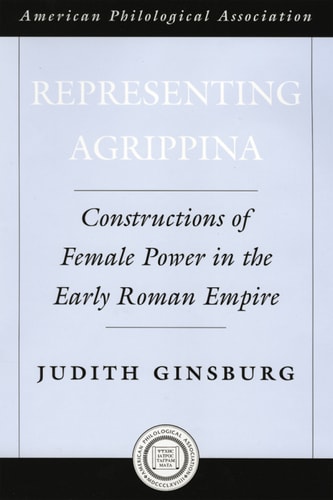
Representing Agrippina: Constructions of Female Power in the Early Roman Empire
0
0
As an Amazon Associate and affiliate partner, Menrva Books earns from qualifying purchases. Learn more
Author Description
Agrippina the Younger, wife of the emperor Claudius and mother of his successor Nero, wielded power and authority at the center of the Roman empire in ways unmatched by almost any other woman in Roman history. Such, at least, is the portrait of Agrippina delivered by our sources and perpetuated in modern scholarship. In this posthumous work, Judith Ginsburg provides a fresh look at both the literary and material representations of Agrippina. Unlike previous treatments, she seeks neither to condemn nor to rehabilitate Agrippina. Nor does she endeavor to exhume the "real Agrippina" from the embellished or fabricated portraits found among the ancients. Ginsburg trains her focus on the representations themselves. Her painstaking dissection of the portrayals by historians exposes the rhetorical tropes, the recurrent motifs, and the craft that shaped the literary image of Agrippina. The designs, as Ginsburg shows, were more than literary flourishes. They aimed to blur the boundaries between the domestic and the imperial realms, deploying the image of Agrippina as domineering wife and mother to suggest the flaws and instability of the regime, a dysfunctional family entailing a dysfunctional system of governance. Gender inversions at home played themselves out on the public scene as imperial rule compromised by female ascendancy. Distorted stereotypes of the "wicked stepmother," the domineering woman, and the sexual transgessor were applied to underscore the violations of status and disruption of gender relations that characterized the imperial administration. Ginsburg has as keen an eye for visual (mis)representations as for literary ones. The depictions of Agrippina on coinage and statuary provide a stark contrast with the written evidence. She appears as matron and priestess, emblematic of domestic rectitude and public piety, and a central figure in the continuity of the dynasty. Ginsburg incisively demonstrates the means whereby Agrippina's imagery was molded both to se
Menrva's Summary
THE THESIS
This work investigates how the literary and material representations of Agrippina the Younger were constructed to reflect and critique the political instability of the early Roman Empire. Judith Ginsburg, a scholar of Roman history, analyzes the rhetorical and visual strategies employed by ancient sources to frame Agrippina as a symbol of domestic and imperial dysfunction. By moving beyond the search for a historical 'real' Agrippina, the author provides a framework for understanding how gendered tropes were utilized to articulate anxieties regarding the transition of power during the Julio-Claudian dynasty.
THE SCOPE MAP
What You Will Find
- Analysis of literary portrayals by ancient historians including Tacitus and Suetonius
- Examination of visual evidence found in coinage and imperial statuary
- Discussion of rhetorical motifs such as the 'wicked stepmother' and 'sexual transgressor'
- Exploration of the intersection between domestic gender roles and imperial governance
Scope Limits
- The book does not attempt to reconstruct the biographical reality of Agrippina's life
- It does not provide a comprehensive political history of the entire Julio-Claudian period
THE AUTHORITY PERSPECTIVE
Scholars recognize this work as a significant contribution to the study of Roman historiography and the gendered nature of imperial power. Readers frequently note the analytical precision with which Ginsburg contrasts written narratives against material evidence to expose the mechanics of ancient political propaganda.
Page Count:
223
Publication Date:
2005-01-01
Publisher:
Oxford University Press
ISBN-10:
0190292768
ISBN-13:
9780190292768
Biography
History
Ancient - Rome
Ancient History
Gender Studies
Political History
Community Tags
Other Editions(3)

Similar Books








Reader Comments
Share Your Thoughts
No comments yet. Be the first to share your thoughts!