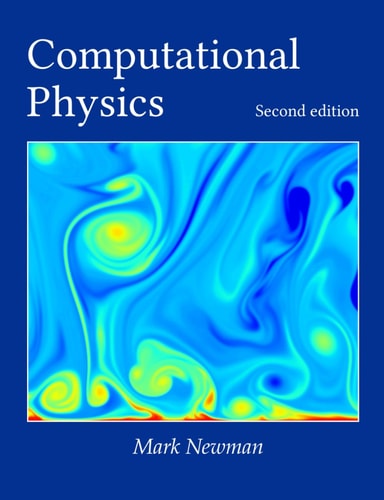
Computational Physics
0
0
As an Amazon Associate and affiliate partner, Menrva Books earns from qualifying purchases. Learn more
Author Description
A complete introduction to the field of computational physics, with examples and exercises in the Python programming language. Computers play a central role in virtually every major physics discovery today, from astrophysics and particle physics to biophysics and condensed matter. This book explains the fundamentals of computational physics and describes in simple terms the techniques that every physicist should know, such as finite difference methods, numerical quadrature, and the fast Fourier transform. The book offers a complete introduction to the topic at the undergraduate level, and is also suitable for the advanced student or researcher who wants to learn the foundational elements of this important field. This second edition is substantially revised and updated, with significant new material, particularly in the areas of numerical integration and differentiation, interpolation, ordinary and partial differential equations, and data analysis, and all of the text and code has been updated for the latest versions of Python and accompanying software.
Menrva's Summary
THE THESIS
This book provides a comprehensive introduction to computational physics, equipping readers with essential numerical techniques and programming skills. It details fundamental methods such as finite difference methods, numerical quadrature, and the fast Fourier transform, explaining their application in modern physics research across various subfields. The text is structured for undergraduate students but also serves as a valuable resource for advanced learners and researchers seeking to master the foundational elements of this critical discipline. The second edition significantly expands upon the first, incorporating updated material and code for contemporary Python versions.
THE SCOPE MAP
- Coverage of core computational physics techniques including finite difference methods, numerical quadrature, and the fast Fourier transform.
- Practical examples and exercises implemented using the Python programming language.
- Updated and expanded sections on numerical integration and differentiation, interpolation, and ordinary and partial differential equations.
- New material on data analysis techniques relevant to physics research.
- Code examples updated for the latest versions of Python and associated scientific libraries.
THE AUTHORITY PERSPECTIVE
The book is designed as a complete introduction to computational physics at the undergraduate level, also suitable for advanced students and researchers. Its focus on practical implementation with Python and coverage of essential numerical methods suggest it aims to bridge theoretical physics with computational practice. The updated second edition indicates a commitment to maintaining relevance with current programming standards and expanding its scope in key areas like differential equations and data analysis.
Page Count:
611
Publication Date:
2025-08-23
Publisher:
Independently published
ISBN-13:
9798297765801
Science
Non-Fiction
Python Programming
Numerical Methods
Computational Physics
Community Tags
Similar Books