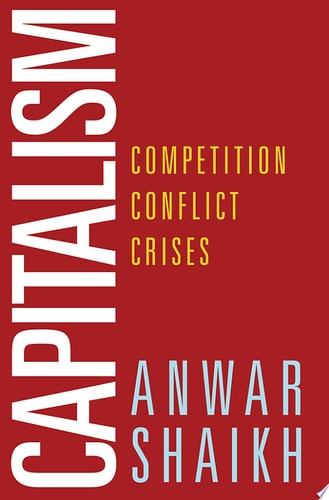
Capitalism: Competition, Conflict, Crises
0
0
As an Amazon Associate and affiliate partner, Menrva Books earns from qualifying purchases. Learn more
Author Description
Orthodox economics operates within a hypothesized world of perfect competition in which perfect consumers and firms act to bring about supposedly optimal outcomes. The discrepancies between this model and the reality it claims to address are then attributed to particular imperfections in reality itself. Most heterodox economists seize on this fact and insist that the world is characterized by imperfect competition. But this only ties them to the notion of perfect competition, which remains as their point of departure and base of comparison. There is no imperfection without perfection. In Capitalism, Anwar Shaikh takes a different approach. He demonstrates that most of the central propositions of economic analysis can be derived without any reference to standard devices such as hyperrationality, optimization, perfect competition, perfect information, representative agents, or so-called rational expectations. This perspective allows him to look afresh at virtually all the elements of economic analysis: the laws of demand and supply, the determination of wage and profit rates, technological change, relative prices, interest rates, bond and equity prices, exchange rates, terms and balance of trade, growth, unemployment, inflation, and long booms culminating in recurrent general crises. In every case, Shaikh's innovative theory is applied to modern empirical patterns and contrasted with neoclassical, Keynesian, and Post-Keynesian approaches to the same issues. Shaikh's object of analysis is the economics of capitalism, and he explores the subject in this expansive light. This is how the classical economists, as well as Keynes and Kalecki, approached the issue. Anyone interested in capitalism and economics in general can gain a wealth of knowledge from this ground-breaking text.
Menrva's Summary
THE THESIS
This book investigates whether the fundamental laws of economic analysis can be derived without relying on the neoclassical assumptions of perfect competition, hyperrationality, or equilibrium. Anwar Shaikh, a professor of economics at the New School for Social Research, challenges both orthodox and heterodox economic frameworks by proposing a classical approach to capitalism. He utilizes extensive empirical data and historical analysis to demonstrate that real-world economic patterns emerge from the competitive, conflict-ridden nature of the capitalist system itself rather than from deviations from an idealized model.
THE SCOPE MAP
What You Will Find
- A comprehensive re-evaluation of supply and demand, wage and profit rates, and technological change.
- Analysis of financial markets including interest rates, bond prices, and equity valuations.
- Empirical comparisons between the author's classical theory and neoclassical, Keynesian, and Post-Keynesian models.
- Examination of long-term economic growth, unemployment, inflation, and the cyclical nature of crises.
Scope Limits
- The text focuses primarily on the structural mechanics of capitalism and does not provide a prescriptive policy manual for individual financial management.
- It does not address micro-level behavioral economics or psychological theories of consumer choice.
THE AUTHORITY PERSPECTIVE
Economists and scholars frequently cite this work as a significant contribution to the revival of classical economic thought, noting the impressive breadth of its empirical integration. Readers often highlight the density of the prose and the rigorous mathematical foundations, making it a challenging but rewarding text for advanced students and professional researchers.
Page Count:
1016
Publication Date:
2016-01-01
Publisher:
Oxford University Press
ISBN-10:
0190298340
ISBN-13:
9780190298340
Economics
Economics history
Capitalism
Social Science
Macroeconomics
Economic Theory
Competition
Macroeconomic Theory
Community Tags
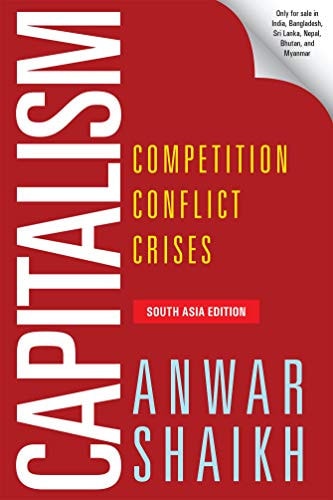
Other Editions(3)
Similar Books







Reader Comments
Share Your Thoughts
No comments yet. Be the first to share your thoughts!