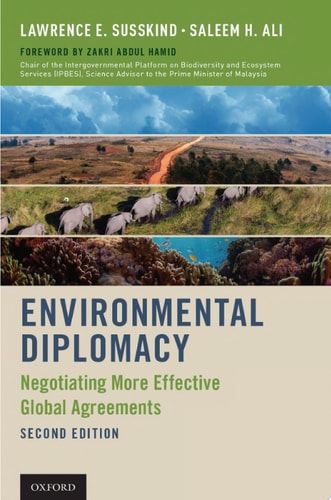
Environmental Diplomacy: Negotiating More Effective Global Agreements
0
0
As an Amazon Associate and affiliate partner, Menrva Books earns from qualifying purchases. Learn more
Author Description
International environmental agreements have increased exponentially within the last five decades. However, decisions on policies to address key issues such as biodiversity loss, climate change, ozone depletion, hazardous waste transport and numerous other planetary challenges require individual countries to adhere to international norms. What have been the successes and failures in the environmental treaty-making arena? How has the role of civil society and scientific consensus contributed to this maturing process? Why have some treaties been more enforceable than others and which theories of international relations can further inform efforts in this regard? Addressing these questions with renewed emphasis on close case analysis makes this volume a timely and thorough postscript to the Rio-Plus 20 summit's celebrated invocation document, The Future We Want, towards sustainable development.Environmental Diplomacy: Negotiating More Effective Global Agreements provides an accessible narrative on understanding the geopolitics of negotiating international environmental agreements and clear guidance on improving the current system. In this book, authors Lawrence Susskind and Saleem Ali expertly observe international environmental negotiations to effectively inform the reader on the geopolitics of protecting our planet. This second edition offers an additional perspective from the Global South as well as providing a broader analysis of the role of science in environmental treaty-making. It provides a unique contribution as a panoramic analysis of the process of environmental treaty-making.
Menrva's Summary
THE THESIS
This volume investigates the mechanisms and efficacy of international environmental treaty-making to determine how global agreements can be structured for greater compliance and impact. Authors Lawrence E. Susskind and Saleem H. Ali utilize their extensive backgrounds in negotiation theory and environmental policy to analyze the successes and failures of past accords. They argue that by integrating scientific consensus and civil society participation, the international community can improve the enforcement and durability of future environmental policies.
THE SCOPE MAP
What You Will Find
- Analysis of major environmental challenges including biodiversity loss, climate change, and hazardous waste management.
- Theoretical frameworks for understanding international relations in the context of treaty negotiation.
- Comparative case studies examining the evolution of environmental diplomacy over the last five decades.
- Perspectives on the role of the Global South in shaping international environmental norms.
Scope Limits
- The text does not provide a comprehensive legal manual for drafting specific treaty clauses.
- It does not offer exhaustive coverage of every minor bilateral environmental agreement signed since the Rio-Plus 20 summit.
THE AUTHORITY PERSPECTIVE
Experts frequently cite this work as a foundational text for understanding the intersection of negotiation theory and environmental governance. Readers often note the clarity of the prose, which makes complex geopolitical processes accessible to both students and practitioners in the field.
Page Count:
244
Publication Date:
2014-01-01
Publisher:
Oxford University Press
ISBN-10:
019029762X
ISBN-13:
9780190297626
Professional Career & Trade
International relations
Sustainability
Diplomacy
Community Tags
Similar Books