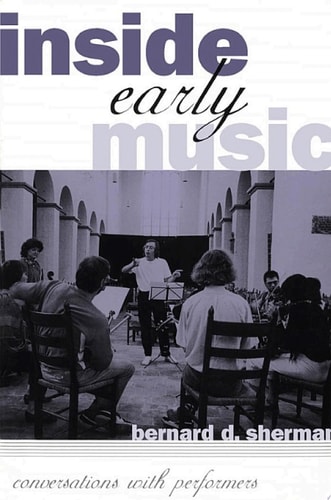
Inside Early Music: Conversations with Performers
0
0
As an Amazon Associate and affiliate partner, Menrva Books earns from qualifying purchases. Learn more
Author Description
The attempt to play music with the styles and instruments of its era--commonly referred to as the early music movement--has become immensely popular in recent years. For instance, Billboard's "Top Classical Albums" of 1993 and 1994 featured Anonymous 4, who sing medieval music, and the best-selling Beethoven recording of 1995 was a period-instruments symphony cycle led by John Eliot Gardiner, who is Deutsche Grammophon's top-selling living conductor. But the movement has generated as much controversy as it has best-selling records, not only about the merits of its results, but also about the validity of its approach. To what degree can we recreate long-lost performing styles? How important are historical period instruments for the performance of a piece? Why should musicians bother with historical information? Are they sacrificing art to scholarship? Now, in Inside Early Music, Bernard D. Sherman has invited many of the leading practitioners to speak out about their passion for early music--why they are attracted to this movement and how it shapes their work. Readers listen in on conversations with conductors Gardiner, William Christie, and Roger Norrington, Peter Phillips of the Tallis Scholars, vocalists Susan Hellauer of Anonymous 4, forte pianist Robert Levin, cellist Anner Bylsma, and many other leading artists. The book is divided into musical eras--Medieval, Renaissance, Baroque, and Classic and Romantic--with each interview focusing on particular composers or styles, touching on heated topics such as the debate over what is "authentic," the value of playing on period instruments, and how to interpret the composer's intentions. Whether debating how to perform Monteverdi's madrigals or comparing Andrew Lawrence-King's Renaissance harp playing to jazz, the performers convey not only a devotion to the spirit of period performance, but the joy of discovery as they struggle to bring the music most truthfully to life.
Menrva's Summary
THE THESIS
How can contemporary musicians authentically recreate historical performance styles while balancing artistic expression with scholarly research? Bernard D. Sherman, a writer and musician, compiles a series of interviews with prominent figures in the early music movement to investigate the philosophical and technical challenges of period-informed performance. By engaging with conductors, vocalists, and instrumentalists, the author examines whether historical accuracy enhances or restricts the emotional impact of classical compositions.
THE SCOPE MAP
What You Will Find
- Historical performance practices spanning the Medieval, Renaissance, Baroque, and Classic/Romantic eras.
- Technical discussions regarding the use of period-accurate instruments versus modern alternatives.
- Debates concerning the interpretation of composer intent and the definition of musical authenticity.
Scope Limits
- The text does not provide a comprehensive history of music theory or notation.
- It does not serve as a practical instructional manual for playing specific period instruments.
THE AUTHORITY PERSPECTIVE
Experts and musicologists frequently cite this collection as a foundational resource for understanding the motivations and methodologies of the early music movement. Readers often note that the conversational format makes complex musicological debates accessible to both professional musicians and interested listeners.
Page Count:
430
Publication Date:
2003-01-01
Publisher:
Oxford University Press
ISBN-10:
0190290811
ISBN-13:
9780190290818
Music
Music History
Interviews
Music Performance
Humanities
Community Tags
Similar Books