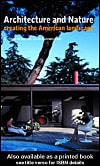
Architecture and Nature
0
0
As an Amazon Associate and affiliate partner, Menrva Books earns from qualifying purchases. Learn more
Author Description
The word "nature" comes from natura, Latin for birth - as do the words nation, native and innate. But nature and nation share more than a common root, they share a common history where one term has been used to define the other. In the United States, the relationship between nation and nature has been central to its colonial and post-colonial history, from the idea of the noble savage to the myth of the frontier. Narrated, painted and filmed, American landscapes have been central to the construction of a national identity. This book offers an in-depth look at how changing ideas of what nature is and what it means for the country have been represented in buildings and landscapes over the past century. It begins with the close of the frontier and the rise of the conservation movement in the 1890s, and it ends with the opening of the "final" frontier of outer space and the rise of the ecology movement in the 1960s. In this seventy five year period, certain American myths about nature have endured while others have been invented, reworked or abandoned.; The buildings and landscapes that have resulted from this dynamic process represent the dreams and ambitions of the country for its relationship to nature: the architecture of the National Parks, the streamlined dams of the Tennessee Valley Authority, the modernist dream houses of post war California, and the geodesic domes of the countercultural sixties. Each of these buildings and landscapes were iconic representations in their era - symbolizing a perfect ideal for life in harmony with nature. Commissioned by either government or business interests, they can be seen as way stations in the development of a national identity. We explore the meanings of these seemingly familiar buildings from a new perspective, using them to shed light on the country's complex and often controversial relationship to nature.
Menrva's Summary
THE THESIS
This book investigates how shifting American cultural perceptions of nature have been physically manifested in architecture and landscape design between the 1890s and the 1960s. Christine Macy, an expert in architectural history, examines the intersection of national identity and environmental ideology. By analyzing iconic structures from the conservation movement to the rise of ecology, the author argues that buildings serve as symbolic way stations that reflect the evolving, often contradictory, relationship between the American nation and the natural world.
THE SCOPE MAP
What You Will Find
- Historical analysis of American landscape and architectural development from 1890 to 1960.
- Examination of iconic projects including National Park infrastructure, Tennessee Valley Authority dams, and mid-century modern residential designs.
- Critical exploration of the relationship between government-commissioned projects and the construction of national identity.
- Theoretical framework connecting the etymology of 'nature' and 'nation' to colonial and post-colonial history.
THE AUTHORITY PERSPECTIVE
Scholars and architectural critics recognize this work as a significant contribution to the study of how built environments reflect ideological shifts in national identity. Readers frequently note the academic rigor of the prose and the author's ability to synthesize complex historical narratives with specific architectural case studies.
Page Count:
372
Publication Date:
2004-01-01
Publisher:
Taylor & Francis Inc
ISBN-10:
0203408454
ISBN-13:
9780203408452
History
Architecture
Histoire
Nonfiction
American History
Environmental aspects of Architecture
Sustainability & Green Design