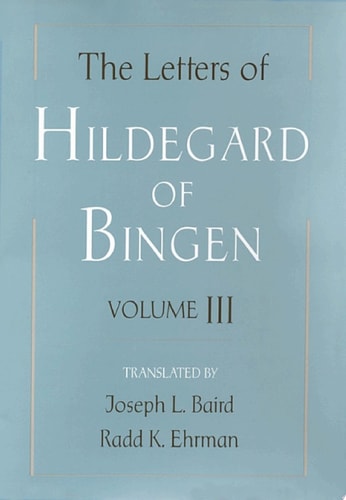
The Letters of Hildegard of Bingen: Volume 3
0
0
As an Amazon Associate and affiliate partner, Menrva Books earns from qualifying purchases. Learn more
Author Description
This is the third and final volume of the complete annotated correspondence of the extraordinary nun, Hildegard of Bingen (1098-1179). One of the most remarkable women of her day, Hildegard was, for more than 30 years, an unflinching advisor and correspondent of all levels of church and society, from popes and kings to ordinary lay persons, from Jerusalem to England. This present volume (letters 218-390) is noteworthy for its large collection of letters to a non-ecclesiastical audience, and because it contains letters not just to such high-ranking notables as Frederick Barbarossa, King Henry II of England, or Eleanor or Acquitaine, but also to common, ordinary individuals of no importance whatsoever, save that they received a letter from Hildegard of Bingen. Addressing matters as diverse as the "humors" and their relation to health and salvation, the fate of departed souls, the frequency and horror of homicide in her age, a means of exorcising malignant spirits, an effective kind of incantation to alleviate nightmares, the proper attitude and response to the fact of excommunication, and male infidelity in marriage, Hildegard provides a unique view of the twelfth century world. Here also are found compositions in epistolary style that are actually sermons, mediations, prayers, or treatises on a wide range of theological topics, such as prophecy, celebration of the Mass, the Lord's Prayer, the creation, and the fall of Adam. Like previous volumes, the translation follows the most recent definitive Latin text, in which the letters are organized according to the rank and station of Hildegard's correspondents.
Menrva's Summary
THE THESIS
This volume investigates the breadth of Hildegard of Bingen's influence and intellectual reach through her extensive correspondence during the twelfth century. As a prominent abbess and visionary, Hildegard utilized these letters to provide moral, theological, and practical guidance to a diverse array of recipients ranging from monarchs to common laypeople.
THE SCOPE MAP
What You Will Find
- Annotated translations of letters 218 through 390.
- Correspondence addressed to high-ranking figures such as Frederick Barbarossa and Eleanor of Aquitaine.
- Discussions on medieval medicine, theological treatises, and social issues including homicide and marriage.
- Epistolary compositions functioning as sermons, prayers, and meditations.
Scope Limits
- The text is limited to the specific correspondence included in this third volume.
- It does not provide a comprehensive biography of Hildegard's entire life, focusing instead on the content of these specific letters.
THE AUTHORITY PERSPECTIVE
Scholars and historians regard this collection as a vital primary source for understanding the social and theological landscape of the twelfth century. Readers frequently note the academic density of the prose and the meticulous nature of the annotations provided by the translators.
Page Count:
232
Publication Date:
2004-01-01
Publisher:
Oxford University Press
ISBN-10:
0190290641
ISBN-13:
9780190290641
Religion
History
Biography
English & College Success
Epistolary
English
Theology
European History
Community Tags
Similar Books